Milton Friedman used to advise researchers to focus on large policy changes rather than attempting to separate a small change’s signal from the noise. In this sense, the “ambitious” policy agenda of the Biden-Harris administration was expected to be a gift to the research community.
Accepting this gift, since 2020 I have been making forecasts of some of the consequences of those policies. Now is a good time to assess the accuracy of those forecasts, which relate to aggregate labor markets, insurance price controls, and drug price controls.
As promised, Biden and Harris redistribute income with health insurance expansions and student-loan forgiveness, although not necessarily in the Robin Hood direction. They give union bosses more tools for reducing competition in the labor market. They try to regulate the internet as a public utility. They distort healthcare markets in many ways, including a new ban on short-term health insurance plans, and granting selected companies a monopoly on a generic drug. They go significantly further than the Obama administration in terms of requiring the private sector to change behavior in ways the bureaucrats expect to reduce carbon emissions. At great human-capital expense, they enabled teacher unions and blue-state governments to maintain “social distancing” far longer than warranted.
The exhaustive list would have more than 1,000 entries. Overall, even the federal agencies’ own low-ball estimates of the costs of the regulations finalized 2021-24 are almost $2 trillion.
1. Macro Performance
Four years ago, I released a study with Kevin Hassett, Tim Fitzgerald, and Cody Kallen of the economic effects of candidate Biden’s agenda compared to President Trump’s. Knowing that campaign promises do not necessarily turn into policy, we analyzed several policy scenarios. The scenario closest to the portfolio of policy changes over the past four years we called “capital taxation constant” (CTC). Biden-Harris climate regulations proved to be somewhat more aggressive than represented by the CTC scenario including, for example, a requirement that manufacturers of medical inhalers (sic) either cease production or convince the Environmental Protection Agency that they are earnestly seeking lower-emission technologies. On the other hand, as nonlawyers we did not account for such a high failure rate of Biden-Harris rules in federal courts.
Under the CTC scenario, labor and capital would be 5.0 percent below the Trump baseline in the long run. In tomorrow's Wall Street Journal, we show that a single trend fits the data well from 2017-Q1 through 2021-Q4, except for the first full pandemic quarter. Then inflation hit and employee compensation—and national income more broadly, which isn’t shown in the chart—fell 5 percent behind. To be more precise, the latest data (2024-Q2) show inflation-adjusted employee compensation per adult to be 4.6 percent below the trend.
Arguably, human capital would have fallen somewhat below its trajectory after 2020 due to pandemic behaviors unrelated to Biden-Harris policies. By itself, this would have pulled labor income somewhat below its prior trend for several years. On the other hand, with some of the regulations not taking effect until 2025 and beyond, we have not yet seen the full effect of the Biden-Harris policies. Large language models and other “AI” technologies have been a positive growth effect that was unanticipated in 2020 when we made the forecasts.
We used a closed-economy model (tariffs were modeled like other excise taxes) that imposes a constant labor’s share, a constant depreciation rate, no statistical discrepancy, and equality between GNP and GDP. In reality, labor’s share of national income has been pretty constant, but the national income’s share of GNP has fallen a bit. More significant has been a fall in the ratio of GNP to GDP. Conversely, a real GDP per capita chart would look “better” than our compensation chart, which of course is no consolation for workers.
Mr. John P. Coale was one of the plaintiffs’ lawyers that initiated the first tobacco settlement agreements, which included a historic and ingenious scheme for individual states to levy the economic equivalent of national (sic) excise taxes. The scheme has been a topic in my excise-tax lectures for as long as I have been teaching them. Let’s not forget that Mr. Coale entered the fray when tobacco companies were thought to be invincible in the litigation arena.
I met Mr. Coale in Atlanta this year (2022), at an awkward meeting of Republicans – awkward because he is a trial lawyer, which is an occupation that perennially gets its regulatory favors from Democrats (President Trump’s deregulation team took pride in cutting out those favors, e.g., Fair Pay and Safe Workplaces EO, CFPB Arbitration rule, the Fiduciary rule, the Borrower defense rule, the NLRB "Murphy Oil" Rule, and NLRB workplace grievances).
Mr. Coale was and is suing big tech on behalf of Donald Trump, accusing them of violating the 1st Amendment of the U.S. Constitution as “state actors.” He cited (as I remember) the 1989 Supreme Court case Skinner v Railway Labor Executives’ Association, finding that “Although the Fourth Amendment does not apply to a search or seizure, even an arbitrary one, effected by a private party on his own initiative, the Amendment protects against such intrusions if the private party acted as an instrument or agent of the Government.” This conclusion is even more compelling for the first amendment, Coale says.
I wondered, with much skepticism, whether his big tech case might be anywhere near as spectacular as the big tobacco ones. Now it appears that big tech was even more integrated with the federal government than Mr. Coale initially accused. And Elon Musk did the discovery for him.
We now have lots of measures of diversity in the academy, by which I mean heterogeneity in race, gender, geography, political attitudes, etc. At this weekend's Stanford Conference on Academic Freedom, much discussion focused on the chasm between the political composition of the academy and the general population. A debate ensued as to whether/how this is related to academic freedom and whether/how public policy should advance affirmative action for "deplorables" (we deplorables use that term affectionately).
Such regulation is likely dangerous and imprudent, in part because the incidence of such diversity is poorly understood. Small, and not necessarily frequent, voluntary actions can make a big difference.
I first noticed this as a college student circa 1990 when political correctness was surging. Moreover, the large majority of my college classmates were quite unserious about academics, putting more time and effort into various extracurriculars and activism (South Africa was one of the big topics). But adapting to the latter was pretty easy. I fulfilled distribution requirements by taking courses like physics and computer science with the respective majors rather than the general ed versions that were watered down by popular demand. I took many economics courses in the graduate schools and over at MIT.
While extremely serious about their studies, the graduate students were politically correct too. More salient to me was a fair bit of group think around both policy and technical issues. It seemed to me that they too uncritically accepted the Keynesian visions of much of the faculty. Dynamic programming was nonexistent until Benabou (MIT) and Leahy (Harvard) came to town during my senior year, and still was quite a niche topic. With some effort I found Stokey-Lucas-Prescott at Harvard Press, but I searched what seemed like every bookstore in the greater Boston area for Sargent's Dynamic Macro Theory (also a Harvard Press book) until finally acquiring a copy during a Christmas-break-blizzard trip to the Seminary Coop in Chicago.
During a typical day on campus I would attend class, say, asking Professor Larry Summers something like "the trade deficit is a real variable -- why should nominal variables like currencies be our primary explanation of why they change over time?" [He and Feldstein were teaching that the U.S. trade deficit had to decline, which required a significant depreciation of the US $ especially vs the yen]. Summers especially would often provide a mocking answer, typically provoking a hearty laugh among my classmates.
Here Robert Barro made a big difference without necessarily much effort [he invested in us students in many other ways too, but that is another topic]. The small number of students (of various ages) with interests closer to mine ended up working with Barro, and that's how we students met each other. Barro had an extra desk on the second floor of NBER that I shared with Xavier Sala-i-Martin, Randy Kroszner, and (at various times) Michael Kremer, Serge Marquie, Jaume Ventura, and Holger Wolf. After classes I would go to the NBER and recount my classroom exchanges with Xavier, Randy, etc. With them as a friendly sounding board, I suffered no harm from Summers' nonanswers [see also the sequel in WSJ and WaPo]. Quite the opposite. Their support helped me learn to stand on my own, and helped me find the few dynamic programmers in town (Barro would take several of us to Hoover one summer where I also met Sargent, McGratten, Judd, and others with overlapping interests). I was learning that even the "smartest" people at the best universities had vulnerabilities in their arguments, which were betrayed by a refusal to engage.
The lesson here is that faculty can help a lot just by helping students find each other, especially on intellectual dimensions like those mentioned above. As long as the intellectual minority is not so small as one, they can get a better education than the majority do. Sheer numbers automatically exposed me to the group think, while just a few minority friends can be enough to facilitate engaging alternatives. The raw distribution on campus need not be anywhere near the population distribution for at least the minority to benefit from intellectual diversity.
Several of the participants at this weekend's conference reported similar experiences. Being alone is tough, but a few sympathetic colleagues go a long way. Indeed, having the conference helped with that too. The sorting aspect reminds me of Milton Friedman's description of the formation of the Mont Pelerin Society in 1947, which seemed quaint and anachronistic in 1998 but suddenly now needed as much as ever.
To be clear, my classmates did not gang up on me for being skeptical of the prevailing views. Politically incorrect views did occasionally spawn cancellation campaigns, although not as frequently as today. Certainly numbers play a role in mob rule, although even today the mob itself is already a minority, albeit outspoken.
Please let me know how this so-called "Inflation Reduction Act" reduces inflation. Here's what's actually in it:
Major items
Alternative minimum tax for corporations Sec 10101
This raises the level of business taxation, which reduces real wages.
IF it reduced the dispersion of business taxation, that would be a force toward increasing real wages to help offset the level effect. BUT see below on the dozens of IRA provisions that increase the dispersion of business taxation.
Gives the Treasury Secretary the authority to determine an individual corporation's tax liability! Sec 10101 (a)(2)(C), (a)(13)
[I changed my mind: I want to be Treasury Secretary!]
Close the "carried interest loophole" Sec 10201
$80B for IRS Sec 10301
3 types of drug price controls
Prices set by HHS for selected Medicare drugs Sec 1191 [I think the Senate typist meant Sec 11091]
Inflation rate cap for Part B drugs (obtained at hospitals and clinics rather than pharmacies) Sec 11101
Inflation rate cap for Part D drugs (obtained at pharmacies) Sec 11102
Medicare Part D (i.e., drug plans for seniors) insurance-benefit floors and reduced subsidy rates Secs 11201-11202, 11401
Both benefit floors and subsidy-rate cuts will increase Medicare Part D premiums. The net result could be more subsidy $ and more drug-plan expenses for most seniors.
One insurance-benefit floor (Sec 11201) requires that enrollees have 100% of their pharmacy bill covered after they have spent $2k for the year. Another (Sec 11202) does the same on a monthly basis (roughly $150 per month).
A third insurance-benefit floor is for vaccines Sec 11401
Zero is a dangerous number for a price!
The 80% Medicare subsidy associated with these transactions is cut sharply. This by itself would reduce distortions in the program.
Remember that Part D premiums are already about 75% subsidized. At that rate (which will increase -- see below), the government expense for Part D could well increase.
Increases in subsidies for Medicare Part D premiums Sec 11404
Specifically, expanding eligibility for "low-income" premium subsidies
Budget gimmick courtesy of Alex Azar: repeal rebate rule Sec 11301
This rule would have prevented drug manufacturers from competing for Medicare Part D business by offering rebates, thereby sharply increasing Medicare Part D premiums and the government's Part D expenses.
On paper, repealing this rule would reduce the federal deficit. However, many expect that the rule would be struck down in court (regardless of whether the IRA repeals it), especially now that agencies have less latitude in reinterpreting statutes. Hence this savings is a budget gimmick.
I explain in Chapter 10 of yourehiredtrump.com how HHS Secretary Azar concocted this rule. We warned him and Trump that Democrats would, via a budget gimmick like this, use the rule to "fund" their big-government programs.
Extend the "temporary" Obamacare expansions that were put in place during the pandemic Sec 12001
Clean energy tax credits Secs 13101-13802
291 pages of the Green Dream!
Interestingly, Sec 13105 increases credit for nuclear power plants, but just those already built. Intended to slow down nuke-plant closures?
Otherwise "clean" refers to the various technologies that are in vogue, including bio fuels and battery manufacturing
Get a tax credit for purchasing a used Electric Vehicle Sec 13402
$4K or %30 of sale price
But only for households with AGI less than $150K and EVs selling for less than $25K
Must go through a car dealer
Limit of one credit per vehicle lifetime
Limit of one credit per taxpayer per 3 years
As a result, the federal government will be granted EV credits when:
EVs are produced,
EVs are sold new, and
EVs are sold used
$20B for agricultural conservation programs Secs 21001 and 21002
Appropriations for clean energy programs ($80-85B total)
Another 100+ pages of the Green Dream, not to be confused with clean energy tax credits (291pp).
$2B subsidies for "Electric loans for renewable energy" Sec 22001
Biofuel subsidies Sec 22003
$10B for rural electric cooperatives Secs 22004 and 22005
$15B for Greenhouse Gas Reduction Fund Sec 60103
$1B for HUD clean energy projects Sec 30002
$3B for NOAA climate resilience projects Secs 40001-40007
$10B to subsidize switching from natural gas appliances to electric Secs 50111-50123
$1B to subsidize zero building energy code adoption Sec 50131
$14B for DOE loans and grants Secs 50141-50145
$3B for electricity transmission subsidies Secs 50151-50153
$6B for the Office of Clean Energy Demonstrations Sec 50161
$2B various other DOE Secs 50171-50173
$1B for clean heavy-duty vehicles Sec 60101
$3B for clean energy programs for ports Sec 60102
$6B for various pollution-reduction programs Secs 60113-60116
$3B for Environmental and Climate Justice Grants Sec 60201
$5.5B for various other clean energy/environment Secs 60502-60506
$3B for USPS clean fleet Sec 70002
Taxing fossil fuels
Increase royalty rate on offshore oil and gas by about 4 percentage points Sec 50261
Increase royalty rate on onshore oil and gas by about 4 percentage points Sec 50262
Both royalty rates are expanded to flared gas Sec 50263
Methane Emissions Charge Sec 60113
Permanent extension of tax on coal Sec 13901
Roughly $1 per ton. For context, coal prices were sometimes below $50/ton before the pandemic
Smaller items
Eliminating cost sharing for vaccines in Medicaid and CHIP Sec 11405
Changes to Medicare payments for biosimilars (Secs 11402 and 11403)
Reinstate superfund Sec 13601
Research credit for small businesses Sec 13902
$5B for forestry subsidies Secs 23001-23005
$0.5B to further carry out the 1950 Defense Production Act Sec 30001
$1B for National Park Service and Bureau of Land Management Secs 50221-50223
$0.6B various water Secs 50231-50241
Regulation of offshore wind leasing Sec 50251
Some kind of extension of offshore leasing program Sec 50264
Limit encroachment of offshore windmills onto areas under lease for offshore drilling Sec 50265
Various other DOE and DOI Secs 50271-50303
Various other EPA programs (less than $1B) Secs 60104-60112
Small amounts for Council on Environmental Quality Secs 60401-60402
$4B for Endangered species programs Secs 60301-60302
$2B for Neighborhood Access and Equity Grant Program Sec 60501
U.S. Senators are proposing to put both retail and business-to-business price controls on insulin. The (intended?) result will that be that consumers will pay more, diabetes complications will get worse, and incumbent manufacturers will make more money.
Drugs generally follow a life cycle. Unique new drugs often command a high price that soon falls sharply as the incumbent faces competition from alternative therapies and/or generics. Insulin has the same kind of life cycle. Two biosimilars (essentially a generic version of a biologic, which is a more complicated type of drug) were quickly approved under one of the new approval pathways created by the Trump Administration that helped bring prices down (explained further in my forthcoming Journal of Law and Economics paper). Seven more biosimilars are in the approval pipeline and will soon be competing with the incumbents.
The incumbents would like to freeze time before those competitors arrive, and Senators Shaheen and Collins are obliging. While they advertise freezing the retail price at $35 plus inflation, they will also impose price controls on the business-to-business transactions that new entrants use to break into the market (read more about them in Chapter 10 of http://yourehiredtrump.com, or in Chapter 13 of my favorite textbook, or in the analysis by OACT and CBO). By hindering the entry and diffusion of the new biosimilars, the price of insulin will not fall as it would have, and usually does over the drug life cycle.
Suppressing competition is exactly what I'd expect Big PhRMA to order up on the Congressional menu (again, see Chapter 10 of http://yourehiredtrump.com). I am less surprised than anyone to again see PhRMA deploy Karl Marx's rhetorical device (he always decried the "middlemen" of capitalism), "This legislation rightly recognizes the role of insurers and middlemen" as they see a PhRMA-protection bill come together.
Consumers will have less choice and pay more as a result of this bill. Adherence to diabetes treatments will be worse than it would have been if this bill were not getting in the way of competition. Low adherence is not just a health problem, but a financial problem too as private and public health plans are saddled with additional hospitalization expenses for treating diabetes complications.
Treasury Secretary Yellen does not see any indicator of an imminent recession.She isn’t looking. The normal economic tailwinds have calmed and, as predicted, Biden's economic policies are a significant headwind.
A recession is sometimes defined
as a reduction in the number employed nationally for a couple of months.Other times it is defined as a reduction in real
GDP for two quarters or more.
When it comes to predicting
events like this, my recursive approach is to first understand where the
general trends are heading.In technical
terms, is the economy’s “steady state” above or below where we are now, and how
much?If the trends are strong up, small
perturbations around that trend will not make a recession.If the trends are flat, then even a small negative
shock will create a recession by one or more of the definitions.Which definition will be triggered can be
assessed by contrasting employment trends with productivity trends.
Four important trends are worth
considering: organic productivity growth, organic population growth, recovery
from the pandemic recession, and new public policies affecting productivity, population,
or employment.
Organic trends
Given that recessions are defined
in absolute rather than per capita terms, population growth is normally an
economic tailwind.However, annual adult
population has fallen from a bit above one percent 1980-2018 to about 0.4
percent.Illegal immigration is a wild
card here because we do not know how many are immigrating, what fraction are adults,
and whether and how those adults will be economically engaged.With that caveat, we now are in a situation
where even a small negative shock that would not have caused a recession in the
one-percent population growth era will now.
Recovery from the pandemic was
also a tailwind.It someday will
continue to lift employment, but at the moment it
looks like employment has recovered as much as it can given
the serious health problems encountered during the pandemic, including but not
limited to self-destructive substance abuse habits that are not complementary
with productive employment.Some of
these people will show up on payrolls but how reliably they show up for work is
another question.Diabetes, liver
disease and heart disease have gotten out of control since 2020.
Workers lost skills and capital
laid idle during the pandemic.These are
recovering, although their recovery will not be fully recognized in the growth
data.GDP and productivity levels were
exaggerated during the pandemic as many goods were unavailable or low quality
in ways not captured by the national accountants.For example, public school teachers stayed
home from school but the national accountants assumed
that they were as productive as ever merely because they continued to get
paid.As they get back to traditional
teaching, this will not be officially recognized as economic progress for the
same reason the pandemic regress was never acknowledged.
Crime has gotten bad, especially
in big cities where productivity is normally the highest.Consumers and businesses are avoiding big cities,
which is a cost (“excess burden”) beyond the crime statistics because the whole
point of the avoidance behaviors is to keep from being one of those statistics.
Fitzgerald, Hassett,
and I predicted
in 2020 that Biden’s economic agenda would reduce the levels of full-time
equivalent employment per capita by 3.1 percent and real gdp
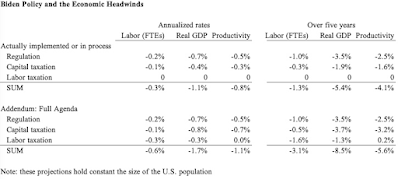
per capita by 8.5 percent.If that level
effect were spread over five years, that would be 0.6 percent per year and 1.7
percent per year, respectively, as shown in the Table as an addendum panel.That by itself makes a recession likely in
one of those five years.
Regulatory Policy
Our analysis of Biden’s agenda distinguished
regulation from capital taxation from labor taxation. His regulatory agenda seems to be going ahead
as we expected.The good news is that Biden’s
nomination of David Weil to the Department of Labor was rejected
by the Senate and Biden was slow to fully mismanage the National Labor
Relations Board.But we did not anticipate
that Biden’s DOL would disrupt labor markets as much as it did with its mask
mandates.Sticking
with our original estimate, it looks that Biden’s regulatory agenda is
reducing employment by 0.2 percent per year (of five years) and real GDP by 0.7
percent per year below the organic trends.See the Table’s top panel.
Of particular concern over the
next few months is the reliability of the
electric grid and air
travel.Snafus of this type are
already built into our regulatory analysis but these examples put more texture
on the economic reasoning that links the marginal regulations with poor
economic performance.
Capital Taxation: Inflation Sneaks
In
Biden’s Build Back Better bill
would implement much of the capital taxation we envisioned in 2020.The good news is that the bill has not yet
passed, and passage of its capital tax elements are not imminent in some other
form.The bad news is that inflation is
taxing businesses without any Congressional action (recall Feldstein
and more
recently Hassett on the effect of inflation on
the cost of capital), while it appears that Biden will let temporary provisions
in the 2017 TCJA expire.With capital
taxation during the Biden administration increasing about half of what we
expected, it would reduce real GDP by about 0.4 percent per year over five
years.
Speaking of inflation, higher Fed Funds rates are already showing up in mortgage rates.In effect, the Federal Reserve is introducing a tax (or cutting a subsidy) on structures investment, which is likely to send at least that sector into a recession.Socially responsible (a.k.a., woke) investing is also skewing the allocation of capital.
Combining capital taxation and
regulation, the headwinds in the Biden economy are 0.25 percent per year for
employment and 1.1 percent per year for real GDP.
Labor Taxation: Direction
Unclear
Labor taxation is an interesting
wild card here.Marginal tax rates on
work were cut sharply when the $300 weekly unemployment bonus expired last
summer.That effect has played out
already.But I expect that Congressional
Democrats, and even some Republicans, will expand unemployment benefits if
anything resembling a recession were occurring.That could easily and quickly reduce employment by one percent, if not
more.On the other hand, various federal
health insurance subsidies are about to expire.If they do (without resurrection), that will encourage work.
Bottom Line
Overall, a recession is highly likely
with so many headwinds and so few tailwinds.A recession is more likely by the GDP definition than the employment
definition.The depth of the recession depends
on how much Congress destabilizes things by further adding to the already large
federal portfolio of programs for the unemployed and poor and further adding to
tax burdens.
Trump's CEA showed, based on credit transactions among manufacturers,
that vehicle standards to abate a ton of CO2 cost about $163 on the
margin, while even Obama said the abatement was worth only $50. i.e., tightening emissions regulations fails a cost-benefit test by a wide margin.
Now Biden claims that new stricter standards pass a cost benefit test.
Although this will be cast as an environmental issue, the new conclusion is driven by assumptions unrelated to environmental economics or climate science:
(1) Consumer fuel savings get (mostly) double counted because "behavioral economics." Specifically,
"The agency’s analysis assumes that potential car and
light truck buyers value only the savings in fuel costs from purchasing a
higher-MPG model they expect to realize over the first 30 months they
own it. Depending on the discount rate buyers are assumed to apply, this
amounts to 25-30 percent of the expected savings in fuel costs over its
entire lifetime." (p. 420 of DOT's final rule)
This double counting (100 - 27.5% = 72.5% of $98 billion in fuel savings) is more than quadruple the purported $16 billion net benefit shown in Table VI-11 of the final rule.
[I call it double counting because, by the principle of revealed prevalence, fuel savings is already built into the price and sales of fuel-efficient vehicles; many consumers do not purchase such vehicles because of the relative price and characteristics of competing vehicles. Alternatively, you could say that DOT ignores benefit of low-MPG vehicles, but the revealed-preference result is the same.
Following an Economics 301 homework solution from October 2019, in December 2020 Trump's CEA provided a vector proof -- that the market price for GHG credits (i) reflects fuel savings as consumers perceive them and (ii) fully quantifies the industry-level real GDP effects of changing GHG standards, without any additional term for fuel savings -- on the White House website. See the appendix of this document.]
By comparison, the gross climate benefit is purportedly $27.5 billion. i.e., they would have to more than double their already inflated "social cost of carbon" to push their thumb on the scale as vigorously as they did with "behavioral economics." See below for more on paternalism.
(2) Biden says that some tightening comes for free because 5
manufacturers had already signed a pledge with California EPA to so
tighten
But this ignores that California rules, when followed by just a subset of manufacturers, do not reduce the supply of federal credits, whereas changes in federal rules do even if the federal rules are not as strict as California's. The equilibrium credit price is built into the prices paid by purchasers of new cars.
(3) When the above are enough to tilt the scale, all costs and benefits are discounted 3%/yr. When an extra push is needed, Biden discounts environmental benefits at 2.5% per year while everything else is
discounted 3%/yr.
"the use of the social rate of return on capital ... inappropriately underestimates the impacts of climate change for the purposes of estimating the SC-GHG. ... the consumption rate of interest is the theoretically appropriate discount rate in an intergenerational context." (p. 547 of the Technical Support Document. See also p. 573 of the final rule.)
More on coercive paternalism
Trump's DOT and EPA spoke forcefully against paternalism as a justification for fuel standards. If people lack knowledge, give them the knowledge rather than imposing a decision on them. Here is how they said it
"the idea that regulating fuel economy and CO2 emissions can mitigate
the consequences of inadequate access to information by placing
decisions that depend on access to complete information in the hands of
regulators rather than buyers has superficial appeal. Yet commenters do
not establish that such a drastic step is necessary to overcome any
inadequacy of information, or that requiring manufacturers to supply
higher fuel economy will be more effective than less intrusive approaches such as expanding the range of information available to buyers." (85 FR 24608, italics added)
In contrast, Biden's DOT and EPA say nothing like this, but instead extol the purported virtues of "behavioral economics." They do not mention less intrusive approaches, let alone show why they would have fewer net benefits.
Covid-19 has disrupted much of human
life, but Operation Warp Speed has drastically mitigated the costs of the
virus. The $10 billion federal program launched in April 2020 encouraged and
accelerated the development and mass manufacturing of COVID-19 vaccines,
streamlined Federal approval for vaccines and their manufacture, and provided
Federal funds for private vaccine research and advance-purchase orders.COVID-19 vaccines are currently being
administered to the general public at least six months earlier than expected.Vaccinating the population against COVID-19
six months earlier was worth about $1.8 trillion to the U.S. alone
in terms of lives saved and accelerating the return to normal schooling, work,
socializing, etc. (Mulligan and Philipson 2020).
Operation Warp Speed is a historic
milestone for economic research on medical innovation that occurred over
decades on the University of Chicago campus.Chicago’s research results, traditions, and emphasis were brought to the
federal government in 2017 by several of its faculty and alumni.In the three years before COVID-19 came to
the United States, that economic team showed the President of the United States
how federal policy reforms were delivering real value to consumers by
encouraging innovation in healthcare industries.Also before the
pandemic, the team prepared and published a blueprint for vaccine innovation
during a pandemic that would become the intellectual foundation for Operation
Warp Speed.This document tells the
story of the program’s University of Chicago origins.The document traces the economics of the
program back to underlying UChicago economic
principles on regulation generally and health economics specifically, following
the contents of a recent
video conversation I had with University of Chicago
colleagues Kevin M. Murphy, Tomas J. Philipson, and Robert H. Topel.
UChicago
on Regulatory Barriers in Healthcare
Operation Warp Speed, especially its
economic elements, emerges from a large body of UChicago
research centered around the unintended consequences of health regulation. Many
economic frameworks developed in the Chicago price theory tradition allow for
both quantitative work and application across various industries. An early
piece by Milton Friedman and George J. Stigler, Roofs or Ceilings? found that housing regulation exacerbated
housing problems rather than making them better (Friedman and Stigler 1946).Stigler would dedicate much of his career to
developing the economics of regulation, including the famous “regulatory
capture theory.”As Stigler put it in
his 1971 paper, “as a rule, regulation is acquired by the industry and is
designed and operated primarily for its benefit … regulatory policy will often
be so fashioned as to retard the rate of growth of new firms” (Stigler 1971).
A famous 1973 paper by Chicago’s Sam Peltzman applied the entry-barrier theory specifically to
the regulation of drugs, vaccines, and medical devices.He observed that the U.S. Food and Drug Administration’s
(FDA) approval procedures amounted to industry entry barriers, concluding that “consumer
losses from purchases of ineffective drugs or hastily-marketed unsafe drugs
appear to have been trivial compared to their gains from innovation” (Peltzman 1973).Peltzman’s approach was appreciated throughout the
profession,[1] including a book from M.I.T. Professor Peter Temin also concluding that FDA
delays were too long (Temin 1980).More
recently, Tomas Philipson and Chicago alumnus Eric Sun concluded that FDA pre-market
regulation and post-market tort liability acted as a double tax on product
development (Philipson and Sun 2008).With Eric Sun and other coauthors, Philipson conducted cost-benefit
analyses of the tradeoff between speed and safety, concluding in 2008 that FDA
was putting too much weight on safety.This work influenced FDA deregulation efforts during the Bush Administration,
although that administration continued to be frustrated by the fact that FDA
“steadily disregarded many of the [] provisions” of laws intended to get FDA to
move faster (Gottlieb 2010).
Regulate or
Deregulate?
Philipson joined the Trump Administration
in 2017 and Mulligan in 2018, both in its White House Council of Economic
Advisers (of which Philipson would ultimately become Acting Chair).These issues arose immediately in connection
with President Trump’s campaign promise to lower prescription drug prices.He appointed FDA Commissioner Scott Gottlieb,
who had been critical of FDA
delays.Trump’s economic team, which included Chicago economists Anna Wong, Don Kenkel, Eric Sun, Kevin Corinth, Paula Worthington, Rich Burkhauser and Troy Durie, predicted that deregulation
would reduce drug prices because reduced FDA barriers would result in more new
drugs and more manufacturers
of existing drugs to compete for consumer dollars.On the other side was Health and Human Services
(HHS) Secretary Alex M. Azar II, who proposed a “drug pricing
blueprint” that would add regulations on
everything from television advertisements to business-to-business
price controls.Although deregulation was a pervasive theme in his administration, the
President was no ideologue but rather just looking for results.
In
a 2018 report that was little noticed at the time (Council of Economic Advisers
2018), CEA laid out and updated Peltzman’s case that
FDA regulations are entry barriers that reduce entry and raise prices.It showed
that Gottlieb’s deregulation was in fact increasing entry of generic drugs and
predicted that lower prices would follow.The CEA received their first sense of progress on January 10, 2019, with
the confidential advance release of the Consumer Price Index (CPI) report for
December 2018.It showed that 2018 was
the first calendar year since 1972 that retail prescription drug prices
actually fell even though consumer prices generally were increasing.The CEA composed a message to be posted on
the President’s Twitter account the next day.But this message had to be approved by HHS, which was loathe
to release something so contrary to its perceived “need for regulatory action”
in the face of purported “prices of existing drugs [that] have been rising in
the United States much more rapidly than warranted by inflation or costs” (United
States, Department of Health and Human Services).Mulligan convinced the President’s
communication team that the CPI is reliable and is telling us something
important. The President would brag
about the result in everything from impromptu press
briefings to his State of the Union address.Although none of us knew what 2020 would
bring, the President was also getting valuable experience at, and witnessing
results from, removing barriers to medical innovation, especially at the FDA.
The Value of Medical
Innovation during a Pandemic
UChicago’s Tomas J. Philipson
and Richard A. Posner founded the field of economic epidemiology, which
emphasized that the costs of a contagious disease are not limited to the health
losses of those who contract the disease because many others upend their lives
in order to stay healthy (Posner and Philipson 1993).In 2006, Kevin M. Murphy and Robert Topel’s “Value of Health and Longevity” assessed the
valuation of improvements in health expenditures and their policy implications
(Murphy and Topel 2006).This study calculated the value of
innovations that occurred in the past, the potential value that can occur in
the future from reducing the incidence, and the mortality of various
diseases.They even looked at the value
of innovation to reduce mortality from contagious respiratory diseases, of
which COVID-19 proved to be an example.Gary
Becker, Tomas Philipson, and Rodrigo Soares estimated the health component of
economic growth associated with the value of health improvements (Becker,
Philipson and Soares 2015).Part of
Becker’s UChicago course on human capital looked at
the value of preventing a worldwide pandemic (Jaffe, Minton, Mulligan and
Murphy 2019).
Chicago’s
emphasis on medical innovation profoundly influenced the White House economic
team.Judging from the 74 Economic
Reports of the President (ERPs) published since the Truman Administration, no
economic team gave so much attention to medical innovation.The 2018 ERP had a full chapter about the
health sector, half of which was about "Improving People’s Health through
More Access to Medical Innovations" and "Encouraging Innovation, and Making It Affordable." The 2019
ERP (p. 18) cites FDA deregulation as one of the highlights of the year and
devotes twelve pages to how FDA reforms increased competition and reduced
prescription drug prices. The same report also looks at the possible
negative innovation effects of a proposed Federal ban on for-profit
healthcare.
The
2020 ERP updated the status of the FDA reforms in its chapter about
deregulation, its chapter about healthcare, and its chapter about competition
policy. It also cited the new Right to Try law and relaxed regulatory
barriers to treating chronic kidney disease (Council of Economic Advisers
2020).
In
order to continue to add to the formidable intellectual capital stock of
Chicago economics, Tomas J. Philipson and Casey B. Mulligan have developed a
new initiative supporting economic research on healthcare markets and medical
innovation. The initiative takes the unique approach of addressing issues
specific to health care through a broader economic lens, applying insights from
industrial organization, macroeconomics, finance, labor economics, and other
fields. Some of the key focus areas investigated so far are FDA hedges,
financial health engineering to support medical research, the effects of
reference pricing on market entry, and innovation incentives and disincentives
in NIH funding. In April of 2020, Mulligan published a report on the excess
burden of COVID-19 and the value of medical innovation that assesses the total
cost of COVID-19 in the U.S. (Mulligan 2020). Later, Mulligan and Philipson estimated
that Project WARP Speed was worth $1.8 trillion due to getting COVID-19
vaccines at least six months before anybody expected. The initiative is
currently planning a conference in the Spring of 2021 around the many issues of
technological change in healthcare, including the measurements and determinants
of these innovations.
Although COVID-19 would not arrive in
the U.S. for two more years, Trump’s CEA was also being asked by the National
Security Council’s biodefense team to look at the economics of vaccine
innovation during pandemics.This was an
opportune time to bring the Chicago tradition on regulation together with its
results on epidemiology and the value of medical innovation.In a report published in September 2019, CEA
concluded that “…improving the speed of vaccine production is more important
for decreasing the number of infections than improving vaccine efficacy” and
emphasized the need for large-scale manufacturing and the possible advantages
of public-private partnerships” (Council of Economic Advisers 2019).
Presidential Human Capital
The
CEA vaccine report prompted a President’s Executive Order, also before the
current pandemic, noting that “viruses emerge from animals … that can spread
efficiently and have sustained transmission among humans.”President Trump concluded that “vaccination
is the most effective defense….”As two
of Trump’s former senior staff members put it “when COVID-19 emerged, the White
House was ready and expeditiously applied the report's deregulatory and fiscal
lessons to streamline FDA approval for vaccines and their parallel
manufacturing on a large scale” (Grogan and Philipson 2020).
Mulligan
and Philipson were in the Oval Office with the President and his economic team
in February 2020 (when COVID-19 cases just were beginning to spread in the U.S.,
and before Operation Warp Speed).His
staff continued to worry that the FDA would not be interested in removing any
more approval barriers.But the
President was confident, telling them that “I’ve done it before and will do it
again … bring the FDA management in here.”He and his administration not only knew why approval barriers needed to
be removed but knew from prior experience how to do it.By the end of that calendar year, two vaccines
were approved, produced, and beginning to be delivered to the American
population.
Bibliography
Becker, Gary, S.,
Tomas J. Philipson, and Rodrigo R. Soares. "The Quantity and Quality of
Life and the Evolution
of World Inequality." American Economic Review, 95 (1): 277-291,
2005.
Council of Economic
Advisers. The Administration’s FDA Reforms and Reduced Biopharmaceutical Drug Prices.
Executive Office of the President, October 2018.
---. Economic Report
of the President. Executive Office of the President, February
2018.
---. Economic Report
of the President. Executive Office of the President, March
2019.
---. Economic Report
of the President. Executive Office of the President, February
2020.
---. Mitigating the
Impact of Pandemic Influenza through Vaccine Innovation.
Executive Office of the President,
September 2019.
Department of Health
and Human Services. “Fraud and Abuse; Removal of Safe Harbor Protection for Rebates Involving Prescription
Pharmaceuticals and
Creation of New Safe Harbor Protection for Certain Point-of-Sale Reductions in
Price on Prescription Pharmaceuticals and Certain Pharmacy Benefit Manager Service Fees.” Federal
Register 84, no. 25 (February 6, 2019): 2340.
Friedman, Milton, and
George J. Stigler. Roofs or Ceilings? The Current Housing Problem.
Irvington-on-the-Hudson,
New York: Foundation for Economic Education, 1946.
Gottlieb, Scott.
"The FDA Is Evading the Law." Wall Street Journal. December
23, 2010. https://www.wsj.com/articles/SB10001424052748704034804576025981869663212.
Grogan, Joseph, and
Tomas J. Philipson. "How the White House Followed the Science to Enable a
Quick Vaccine
." Newsweek. Last modified December 11, 2020. https://www.newsweek.com/how-white-house-followed-science-enable-quick-vaccine-opinion-1553617.
Jaffe, Sonia, Robert
Minton, Casey B. Mulligan, and Kevin M. Murphy. Chicago Price Theory. Princeton, NJ: Princeton University
Press, 2019.
Klein, Daniel B. and
Alexander Tabarrok.Is the FDA Safe
and Effective?Independent
Institute, 2001.
Mulligan, Casey B.
2020. "Economic Activity and the Value of Medical Innovation during a
Pandemic." NBER
Working Paper 27060, National Bureau of Economic Research, Cambridge, MA.
---. "White
House Attitudes toward "Screening Agencies" (looking at you FDA)
" supply and demand (in that
order). Last modified January 2, 2021.
http://caseymulligan.blogspot.com/2021/01/white-house-attitudes-toward-screening.html.
Mulligan, Casey B.,
and Tomas J. Philipson. "Operation Warp Speed: What a Deal!."
Newsweek. Last modified
July 28, 2020. https://www.newsweek.com/operation-warp-speed-what-deal-opinion-1520816.
Murphy, Kevin, and
Robert Topel. "The Value of Health and Longevity." Journal
of Political Economy 114,
no. 5 (October 2006).
Murphy,
Kevin, and Robert Topel.Measuring the Gains from Medical Research.Chicago: University of Chicago Press, 2003.
Peltzman, Sam.“An Evaluation of Consumer Protection
Legislation: The 1962 Drug Amendments.”Journal
of Political Economy.81(5), October
1973: 1049-91.
Philipson,
Tomas, J., and Eric Sun. 2008. "Is the Food and Drug Administration Safe andEffective?" Journal of Economic
Perspectives, 22 (1): 85-102.
Philipson, Tomas J., Ernst R. Berndt, Adrian H.
Gottschalk, and Eric Sun. "Cost Benefit Analysis of the FDA:
The Case of the Prescription Drug User Fee Acts." Journal of Economic
Perspectives 22, no. 1 (December 2008): 85-102.
Posner, Richard A.
and Tomas J. Philipson. Private Choices and Public Health: The AIDS Epidemic
in an Economic
Perspective. Cambridge, MA: Harvard University
Press, 1993.
Stigler, George J.
"The Theory of Economic Regulation." The Bell Journal of Economics
and Management
Science 2, no. 1 (1971): 3-21. Accessed
February 17, 2021. doi:10.2307/3003160.
Temin, Peter.Taking your medicine: drug regulation in
the United States. Cambridge, MA: Harvard University Press, 1980.
U.S. President.
Executive Order. “Modernizing Influenza Vaccines in the United States to
Promote National
Security and Public Health, Executive order 13887 of September 19, 2019.” Federal
Register
84 no. 185 (September 24, 2019): 49935.
The basic tools of supply and demand -- presented and extended in Chicago Price Theory -- help immensely to understand and predict everyday events in our world. These events relate to, among other things, macroeconomics, fiscal policy, health and labor markets, and industrial organization.