"The President shall annually transmit to the Congress not later than 10 days after the submission of the budget ... an economic report (hereinafter in this chapter referred to as the “Economic Report”) together with the annual report of the Council of Economic Advisers...."
Because the budget was submitted March 28, 2022, yesterday was the due date for submitting the 2022 Economic Report of the President. No report has been released in 2022 and neither the White House nor news media have said anything about this year's report.
CEA, like many other government agencies, is funded with public money. It should perform its duties as directed by the public through the statutes duly enacted by its representatives in Congress.
Moreover, CEA is unique from most of the rest of the Executive Office of the President in that it is explicitly created and directed by federal statutes. As it should, this unique statutory basis has elevated CEA's influence within the White House. But if CEA does not comply with the law, what stops the rest of the bureaucracy from treating CEA as just one of many White House Offices and Councils whose entire existence could be erased at the whim of the President or senior staff?
Why the lack of compliance with 15 USC 1022(a)? Here are my guesses, beginning with those I assess to be most likely.
Biden, who must at least meet with CEA and sign the report, is too feeble to perform all of the duties required of him by law and politics. Senior staff have made the tough decision as to which laws will not be followed in order to reserve Biden's energy for other duties.
I am not the only one to notice that it has been a month since Biden had anything on his public schedule later than mid-afternoon.
This theory predicts that no EOP employees get fired.
Biden's senior staff views statutes as mere suggestions, and therefore even a minor logistical challenge would be enough to ignore 15 USC 1022(a).
This is consistent with the fact that the FY 2023 budget (an OMB product) missed the statutory deadline too, which has occurred before when a President was just coming into office or when the deadline occurred during a government shutdown but (I think) is otherwise unprecedented.
Expected punishment is low, under the theory that a Democratic Congress would not hold a Democratic administration accountable.
This possibility is the worst for (among other things) the CEA as an institution because then CEA itself becomes a mere suggestion.
The draft ERP, which likely began in early 2021, contains something that in hindsight is terribly embarrassing to the Biden administration. It either needs to be rewritten or released on a day when other news distracts all of the attention. This is bit unlikely, because the embarrassment would have to be something that the ERP covers that the (much longer) President's Budget does not. On the other hand, this explanation is complementary with the Biden-debilitation story because likely the President would be needed to adjudicate a serious dispute among senior staff. [More generally it would be interesting to know how disputes are resolved when POTUS is debilitated. Does VPOTUS help?]
The current CEA is unaware of 15 USC 1022(a) and what actions are required to comply with it. I doubt this because the CEA chair, Cecilia Rouse, was a CEA member who had helped prepare two prior ERPs (2010 and 2011).
The current CEA is aware of 15 USC 1022(a) and the actions are required to comply with it, but proved incapable of doing its part. I doubt this even more because that puts the President in jeopardy and an army of former CEA staff could have been called to help on a volunteer basis. More time could have been obtained by going downstairs and asking OMB to delay its budget release, which itself was already past the statutory deadline.
Progressives in the administration have objected to even the mildest citation of unintended consequences and the law of demand (mild enough that even Jared Bernstein insists that they be mentioned). Such objections could likely exist, but very unlikely stop the lawful ERP transmittal because
The CEA chair had much time to engage in earnest debate with the rest of the administration (as CEA 45 often did, sometimes for more than a year). In the end she could assert her statutory authority to issue the ERP as she and POTUS see fit.
Possibly the CEA chair would be willing to fudge the economics for the progressive cause, and therefore the dispute would not be reason to miss the statutory deadline.
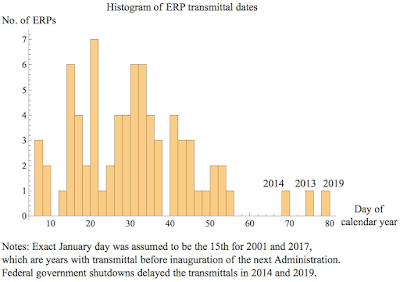
Even if the 2022 ERP is transmitted to Congress next week, it will be more than 100 days into the calendar year, as compared to the previous "record" (lawfully) set in 2019 on the 78th day of the year. 96 percent of all previous ERPs (75 in total) had been transmitted by February 23, which is the 54th day of every year.
Update: ERP 2022 was electronically transmitted April 14, 2022, which was the 104th day of the year and 17 days after the budget submission.
The Joint Economic Committee is the statutory Congressional receiver of the annual ERP. The hard copies, which is usually provided to JEC on the official "day of transmittal," was not delivered until April 25, 2022. This observation adds support to the Biden-disability theory because POTUS at least signs the hard copies.
On the other hand, the excellent CEA45 production editor, Al Imhoff, also served in that role for ERP 2022 (see p. 345). The fact that a second production editor was hired (Kellam worked on Obama-era ERPs) suggests that CEA46 was so late writing its chapters that there was no time for Imhoff to serially process them as he did for CEA45. This hypothesis is also consistent with the fact that many more of CEA45's chapters were released as stand-alone public reports throughout the year (Imhoff was copy editing many of those too), some of which could be entered into ERP production 4-5 months ahead of the statutory deadline.
Trump's CEA showed, based on credit transactions among manufacturers,
that vehicle standards to abate a ton of CO2 cost about $163 on the
margin, while even Obama said the abatement was worth only $50. i.e., tightening emissions regulations fails a cost-benefit test by a wide margin.
Now Biden claims that new stricter standards pass a cost benefit test.
Although this will be cast as an environmental issue, the new conclusion is driven by assumptions unrelated to environmental economics or climate science:
(1) Consumer fuel savings get (mostly) double counted because "behavioral economics." Specifically,
"The agency’s analysis assumes that potential car and
light truck buyers value only the savings in fuel costs from purchasing a
higher-MPG model they expect to realize over the first 30 months they
own it. Depending on the discount rate buyers are assumed to apply, this
amounts to 25-30 percent of the expected savings in fuel costs over its
entire lifetime." (p. 420 of DOT's final rule)
This double counting (100 - 27.5% = 72.5% of $98 billion in fuel savings) is more than quadruple the purported $16 billion net benefit shown in Table VI-11 of the final rule.
[I call it double counting because, by the principle of revealed prevalence, fuel savings is already built into the price and sales of fuel-efficient vehicles; many consumers do not purchase such vehicles because of the relative price and characteristics of competing vehicles. Alternatively, you could say that DOT ignores benefit of low-MPG vehicles, but the revealed-preference result is the same.
Following an Economics 301 homework solution from October 2019, in December 2020 Trump's CEA provided a vector proof -- that the market price for GHG credits (i) reflects fuel savings as consumers perceive them and (ii) fully quantifies the industry-level real GDP effects of changing GHG standards, without any additional term for fuel savings -- on the White House website. See the appendix of this document.]
By comparison, the gross climate benefit is purportedly $27.5 billion. i.e., they would have to more than double their already inflated "social cost of carbon" to push their thumb on the scale as vigorously as they did with "behavioral economics." See below for more on paternalism.
(2) Biden says that some tightening comes for free because 5
manufacturers had already signed a pledge with California EPA to so
tighten
But this ignores that California rules, when followed by just a subset of manufacturers, do not reduce the supply of federal credits, whereas changes in federal rules do even if the federal rules are not as strict as California's. The equilibrium credit price is built into the prices paid by purchasers of new cars.
(3) When the above are enough to tilt the scale, all costs and benefits are discounted 3%/yr. When an extra push is needed, Biden discounts environmental benefits at 2.5% per year while everything else is
discounted 3%/yr.
"the use of the social rate of return on capital ... inappropriately underestimates the impacts of climate change for the purposes of estimating the SC-GHG. ... the consumption rate of interest is the theoretically appropriate discount rate in an intergenerational context." (p. 547 of the Technical Support Document. See also p. 573 of the final rule.)
More on coercive paternalism
Trump's DOT and EPA spoke forcefully against paternalism as a justification for fuel standards. If people lack knowledge, give them the knowledge rather than imposing a decision on them. Here is how they said it
"the idea that regulating fuel economy and CO2 emissions can mitigate
the consequences of inadequate access to information by placing
decisions that depend on access to complete information in the hands of
regulators rather than buyers has superficial appeal. Yet commenters do
not establish that such a drastic step is necessary to overcome any
inadequacy of information, or that requiring manufacturers to supply
higher fuel economy will be more effective than less intrusive approaches such as expanding the range of information available to buyers." (85 FR 24608, italics added)
In contrast, Biden's DOT and EPA say nothing like this, but instead extol the purported virtues of "behavioral economics." They do not mention less intrusive approaches, let alone show why they would have fewer net benefits.
The 2019 Economic Report of the President includes the most extensive economic analysis of Ukraine of any President going back at least to Truman. It discussed:
Historical harms -- including murder -- imposed on Ukraine by Moscow (Chapter 8),
The extensive costs of the collective ownership imposed on Ukrainian agriculture, asking why would collective ownership of healthcare work out any better if the economic incentives were the same (Chapter 8),
How the New York Times covered up and lied about events in Ukraine because the events were incongruent with the leftist fantasies of many of its readers (Chapter 8). Pulitzer Prizes were awarded for those lies!
Ukraine was never even mentioned in an ERP between 1947 and 1992. Nor were any related keywords (see below).
The 1993 ERP noted that Ukraine was among former Soviet republics issuing its own currency in 1992 (pp. 304-5).
The 1994 ERP noted that "[CEA member] Stiglitz traveled to Russia and Ukraine and established an official relationship with the Russian Government's Working Center for Economic Reform." (p. 256)
The 1995 ERP noted that the U.S. engaged in several bilateral investment treaties, including "treaties with the former Soviet republics of Georgia, Ukraine, and Belarus." (p. 249).
The 1997 ERP cited Ukraine in a list of many countries allocated "U.S. non-military bilateral aid" and that in the case of Russia and Ukraine, this aid was for "public health programs" (pp. 264-5). It also cited the "explosion at Chernobyl" as part of a paragraph about "how developing countries treat their environment." [I wish the 2019 ERP had included a section on environmental stewardship by socialist countries, but the idea did not occur to me until much later. The environmental rhetoric was much the same as modern-day socialists'].
On page 167 of the 1998 ERP, it was noted that Ukraine was one among several countries assigned "less stringent" emissions limits by the Kyoto protocol. On page 259, a large list of countries receiving U.S. aid was listed, including Ukraine.
On page 290 of the 1999 ERP, it was noted that currency boards have been recommended for countries such as "Indonesia, Russia, and Ukraine."
Page 260 of the 2001 ERP reports that CEA "initiated a new dialogue with economic officials in Ukraine."
Page 131 of the 2005 ERP includes a box about "The Benefits of Land Titles." Several countries are mentioned in the box, with Ukraine as one of those where "entrepreneurs believe their property rights are secure [and therefore] reinvest ... back in their business."
In a paragraph about the "disadvantages to nuclear power," p. 172 of the 2008 ERP cites the "Chernobyl nuclear power plant in Ukraine."
The 2010 ERP notes the rapid deprecation of "the currencies of Hungary, Poland, and Ukraine" (p. 86).
A footnote on p. 130 of the 2012 ERP explains which countries are included in its emerging markets index. Ukraine is one of 21.
Figure 1-4 of the 2014 ERP has international comparisons of quarterly real GDP time series. Ukraine is one of the countries included. A similar chart is repeated on page 117.
This post was based on text searches for "Ukraine", "Ukrainian," "Holodomor," "Kyiv," "Kiev," or "Chernobyl" in the 1947-2021 ERPs.
The White House Council of Economic Advisers' Annual Report, a.k.a., Economic Report of the President, has not yet been transmitted to Congress as of today, the 89th day of 2022.
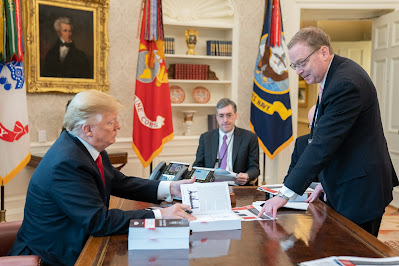
This is the latest ERP transmittal ever, with the previous record being 2019, which was transmitted on the 78th day (signed on the 77th -- see photo below) following a prolonged federal government shutdown.
By law, the ERP must be transmitted to Congress annually. Initially, the deadline was within 60 days of when Congress began its regular session, which is typically January 3. In 1978, that deadline was shortened to 20 (?) days. In 1990, and still today, a 10-day deadline is triggered by the President's Budget submission rather than the Congressional session. That submission occurred on March 28, putting the 2022 ERP deadline at Thursday April 7, 2022.
Unless the law is to be broken by a wide margin, the 2022 ERP will be the first ever issued in April. It will be only the 4th of 76 to be transmitted after February 23.
Covid-19 has disrupted much of human
life, but Operation Warp Speed has drastically mitigated the costs of the
virus. The $10 billion federal program launched in April 2020 encouraged and
accelerated the development and mass manufacturing of COVID-19 vaccines,
streamlined Federal approval for vaccines and their manufacture, and provided
Federal funds for private vaccine research and advance-purchase orders.COVID-19 vaccines are currently being
administered to the general public at least six months earlier than expected.Vaccinating the population against COVID-19
six months earlier was worth about $1.8 trillion to the U.S. alone
in terms of lives saved and accelerating the return to normal schooling, work,
socializing, etc. (Mulligan and Philipson 2020).
Operation Warp Speed is a historic
milestone for economic research on medical innovation that occurred over
decades on the University of Chicago campus.Chicago’s research results, traditions, and emphasis were brought to the
federal government in 2017 by several of its faculty and alumni.In the three years before COVID-19 came to
the United States, that economic team showed the President of the United States
how federal policy reforms were delivering real value to consumers by
encouraging innovation in healthcare industries.Also before the
pandemic, the team prepared and published a blueprint for vaccine innovation
during a pandemic that would become the intellectual foundation for Operation
Warp Speed.This document tells the
story of the program’s University of Chicago origins.The document traces the economics of the
program back to underlying UChicago economic
principles on regulation generally and health economics specifically, following
the contents of a recent
video conversation I had with University of Chicago
colleagues Kevin M. Murphy, Tomas J. Philipson, and Robert H. Topel.
UChicago
on Regulatory Barriers in Healthcare
Operation Warp Speed, especially its
economic elements, emerges from a large body of UChicago
research centered around the unintended consequences of health regulation. Many
economic frameworks developed in the Chicago price theory tradition allow for
both quantitative work and application across various industries. An early
piece by Milton Friedman and George J. Stigler, Roofs or Ceilings? found that housing regulation exacerbated
housing problems rather than making them better (Friedman and Stigler 1946).Stigler would dedicate much of his career to
developing the economics of regulation, including the famous “regulatory
capture theory.”As Stigler put it in
his 1971 paper, “as a rule, regulation is acquired by the industry and is
designed and operated primarily for its benefit … regulatory policy will often
be so fashioned as to retard the rate of growth of new firms” (Stigler 1971).
A famous 1973 paper by Chicago’s Sam Peltzman applied the entry-barrier theory specifically to
the regulation of drugs, vaccines, and medical devices.He observed that the U.S. Food and Drug Administration’s
(FDA) approval procedures amounted to industry entry barriers, concluding that “consumer
losses from purchases of ineffective drugs or hastily-marketed unsafe drugs
appear to have been trivial compared to their gains from innovation” (Peltzman 1973).Peltzman’s approach was appreciated throughout the
profession,[1] including a book from M.I.T. Professor Peter Temin also concluding that FDA
delays were too long (Temin 1980).More
recently, Tomas Philipson and Chicago alumnus Eric Sun concluded that FDA pre-market
regulation and post-market tort liability acted as a double tax on product
development (Philipson and Sun 2008).With Eric Sun and other coauthors, Philipson conducted cost-benefit
analyses of the tradeoff between speed and safety, concluding in 2008 that FDA
was putting too much weight on safety.This work influenced FDA deregulation efforts during the Bush Administration,
although that administration continued to be frustrated by the fact that FDA
“steadily disregarded many of the [] provisions” of laws intended to get FDA to
move faster (Gottlieb 2010).
Regulate or
Deregulate?
Philipson joined the Trump Administration
in 2017 and Mulligan in 2018, both in its White House Council of Economic
Advisers (of which Philipson would ultimately become Acting Chair).These issues arose immediately in connection
with President Trump’s campaign promise to lower prescription drug prices.He appointed FDA Commissioner Scott Gottlieb,
who had been critical of FDA
delays.Trump’s economic team, which included Chicago economists Anna Wong, Don Kenkel, Eric Sun, Kevin Corinth, Paula Worthington, Rich Burkhauser and Troy Durie, predicted that deregulation
would reduce drug prices because reduced FDA barriers would result in more new
drugs and more manufacturers
of existing drugs to compete for consumer dollars.On the other side was Health and Human Services
(HHS) Secretary Alex M. Azar II, who proposed a “drug pricing
blueprint” that would add regulations on
everything from television advertisements to business-to-business
price controls.Although deregulation was a pervasive theme in his administration, the
President was no ideologue but rather just looking for results.
In
a 2018 report that was little noticed at the time (Council of Economic Advisers
2018), CEA laid out and updated Peltzman’s case that
FDA regulations are entry barriers that reduce entry and raise prices.It showed
that Gottlieb’s deregulation was in fact increasing entry of generic drugs and
predicted that lower prices would follow.The CEA received their first sense of progress on January 10, 2019, with
the confidential advance release of the Consumer Price Index (CPI) report for
December 2018.It showed that 2018 was
the first calendar year since 1972 that retail prescription drug prices
actually fell even though consumer prices generally were increasing.The CEA composed a message to be posted on
the President’s Twitter account the next day.But this message had to be approved by HHS, which was loathe
to release something so contrary to its perceived “need for regulatory action”
in the face of purported “prices of existing drugs [that] have been rising in
the United States much more rapidly than warranted by inflation or costs” (United
States, Department of Health and Human Services).Mulligan convinced the President’s
communication team that the CPI is reliable and is telling us something
important. The President would brag
about the result in everything from impromptu press
briefings to his State of the Union address.Although none of us knew what 2020 would
bring, the President was also getting valuable experience at, and witnessing
results from, removing barriers to medical innovation, especially at the FDA.
The Value of Medical
Innovation during a Pandemic
UChicago’s Tomas J. Philipson
and Richard A. Posner founded the field of economic epidemiology, which
emphasized that the costs of a contagious disease are not limited to the health
losses of those who contract the disease because many others upend their lives
in order to stay healthy (Posner and Philipson 1993).In 2006, Kevin M. Murphy and Robert Topel’s “Value of Health and Longevity” assessed the
valuation of improvements in health expenditures and their policy implications
(Murphy and Topel 2006).This study calculated the value of
innovations that occurred in the past, the potential value that can occur in
the future from reducing the incidence, and the mortality of various
diseases.They even looked at the value
of innovation to reduce mortality from contagious respiratory diseases, of
which COVID-19 proved to be an example.Gary
Becker, Tomas Philipson, and Rodrigo Soares estimated the health component of
economic growth associated with the value of health improvements (Becker,
Philipson and Soares 2015).Part of
Becker’s UChicago course on human capital looked at
the value of preventing a worldwide pandemic (Jaffe, Minton, Mulligan and
Murphy 2019).
Chicago’s
emphasis on medical innovation profoundly influenced the White House economic
team.Judging from the 74 Economic
Reports of the President (ERPs) published since the Truman Administration, no
economic team gave so much attention to medical innovation.The 2018 ERP had a full chapter about the
health sector, half of which was about "Improving People’s Health through
More Access to Medical Innovations" and "Encouraging Innovation, and Making It Affordable." The 2019
ERP (p. 18) cites FDA deregulation as one of the highlights of the year and
devotes twelve pages to how FDA reforms increased competition and reduced
prescription drug prices. The same report also looks at the possible
negative innovation effects of a proposed Federal ban on for-profit
healthcare.
The
2020 ERP updated the status of the FDA reforms in its chapter about
deregulation, its chapter about healthcare, and its chapter about competition
policy. It also cited the new Right to Try law and relaxed regulatory
barriers to treating chronic kidney disease (Council of Economic Advisers
2020).
In
order to continue to add to the formidable intellectual capital stock of
Chicago economics, Tomas J. Philipson and Casey B. Mulligan have developed a
new initiative supporting economic research on healthcare markets and medical
innovation. The initiative takes the unique approach of addressing issues
specific to health care through a broader economic lens, applying insights from
industrial organization, macroeconomics, finance, labor economics, and other
fields. Some of the key focus areas investigated so far are FDA hedges,
financial health engineering to support medical research, the effects of
reference pricing on market entry, and innovation incentives and disincentives
in NIH funding. In April of 2020, Mulligan published a report on the excess
burden of COVID-19 and the value of medical innovation that assesses the total
cost of COVID-19 in the U.S. (Mulligan 2020). Later, Mulligan and Philipson estimated
that Project WARP Speed was worth $1.8 trillion due to getting COVID-19
vaccines at least six months before anybody expected. The initiative is
currently planning a conference in the Spring of 2021 around the many issues of
technological change in healthcare, including the measurements and determinants
of these innovations.
Although COVID-19 would not arrive in
the U.S. for two more years, Trump’s CEA was also being asked by the National
Security Council’s biodefense team to look at the economics of vaccine
innovation during pandemics.This was an
opportune time to bring the Chicago tradition on regulation together with its
results on epidemiology and the value of medical innovation.In a report published in September 2019, CEA
concluded that “…improving the speed of vaccine production is more important
for decreasing the number of infections than improving vaccine efficacy” and
emphasized the need for large-scale manufacturing and the possible advantages
of public-private partnerships” (Council of Economic Advisers 2019).
Presidential Human Capital
The
CEA vaccine report prompted a President’s Executive Order, also before the
current pandemic, noting that “viruses emerge from animals … that can spread
efficiently and have sustained transmission among humans.”President Trump concluded that “vaccination
is the most effective defense….”As two
of Trump’s former senior staff members put it “when COVID-19 emerged, the White
House was ready and expeditiously applied the report's deregulatory and fiscal
lessons to streamline FDA approval for vaccines and their parallel
manufacturing on a large scale” (Grogan and Philipson 2020).
Mulligan
and Philipson were in the Oval Office with the President and his economic team
in February 2020 (when COVID-19 cases just were beginning to spread in the U.S.,
and before Operation Warp Speed).His
staff continued to worry that the FDA would not be interested in removing any
more approval barriers.But the
President was confident, telling them that “I’ve done it before and will do it
again … bring the FDA management in here.”He and his administration not only knew why approval barriers needed to
be removed but knew from prior experience how to do it.By the end of that calendar year, two vaccines
were approved, produced, and beginning to be delivered to the American
population.
Bibliography
Becker, Gary, S.,
Tomas J. Philipson, and Rodrigo R. Soares. "The Quantity and Quality of
Life and the Evolution
of World Inequality." American Economic Review, 95 (1): 277-291,
2005.
Council of Economic
Advisers. The Administration’s FDA Reforms and Reduced Biopharmaceutical Drug Prices.
Executive Office of the President, October 2018.
---. Economic Report
of the President. Executive Office of the President, February
2018.
---. Economic Report
of the President. Executive Office of the President, March
2019.
---. Economic Report
of the President. Executive Office of the President, February
2020.
---. Mitigating the
Impact of Pandemic Influenza through Vaccine Innovation.
Executive Office of the President,
September 2019.
Department of Health
and Human Services. “Fraud and Abuse; Removal of Safe Harbor Protection for Rebates Involving Prescription
Pharmaceuticals and
Creation of New Safe Harbor Protection for Certain Point-of-Sale Reductions in
Price on Prescription Pharmaceuticals and Certain Pharmacy Benefit Manager Service Fees.” Federal
Register 84, no. 25 (February 6, 2019): 2340.
Friedman, Milton, and
George J. Stigler. Roofs or Ceilings? The Current Housing Problem.
Irvington-on-the-Hudson,
New York: Foundation for Economic Education, 1946.
Gottlieb, Scott.
"The FDA Is Evading the Law." Wall Street Journal. December
23, 2010. https://www.wsj.com/articles/SB10001424052748704034804576025981869663212.
Grogan, Joseph, and
Tomas J. Philipson. "How the White House Followed the Science to Enable a
Quick Vaccine
." Newsweek. Last modified December 11, 2020. https://www.newsweek.com/how-white-house-followed-science-enable-quick-vaccine-opinion-1553617.
Jaffe, Sonia, Robert
Minton, Casey B. Mulligan, and Kevin M. Murphy. Chicago Price Theory. Princeton, NJ: Princeton University
Press, 2019.
Klein, Daniel B. and
Alexander Tabarrok.Is the FDA Safe
and Effective?Independent
Institute, 2001.
Mulligan, Casey B.
2020. "Economic Activity and the Value of Medical Innovation during a
Pandemic." NBER
Working Paper 27060, National Bureau of Economic Research, Cambridge, MA.
---. "White
House Attitudes toward "Screening Agencies" (looking at you FDA)
" supply and demand (in that
order). Last modified January 2, 2021.
http://caseymulligan.blogspot.com/2021/01/white-house-attitudes-toward-screening.html.
Mulligan, Casey B.,
and Tomas J. Philipson. "Operation Warp Speed: What a Deal!."
Newsweek. Last modified
July 28, 2020. https://www.newsweek.com/operation-warp-speed-what-deal-opinion-1520816.
Murphy, Kevin, and
Robert Topel. "The Value of Health and Longevity." Journal
of Political Economy 114,
no. 5 (October 2006).
Murphy,
Kevin, and Robert Topel.Measuring the Gains from Medical Research.Chicago: University of Chicago Press, 2003.
Peltzman, Sam.“An Evaluation of Consumer Protection
Legislation: The 1962 Drug Amendments.”Journal
of Political Economy.81(5), October
1973: 1049-91.
Philipson,
Tomas, J., and Eric Sun. 2008. "Is the Food and Drug Administration Safe andEffective?" Journal of Economic
Perspectives, 22 (1): 85-102.
Philipson, Tomas J., Ernst R. Berndt, Adrian H.
Gottschalk, and Eric Sun. "Cost Benefit Analysis of the FDA:
The Case of the Prescription Drug User Fee Acts." Journal of Economic
Perspectives 22, no. 1 (December 2008): 85-102.
Posner, Richard A.
and Tomas J. Philipson. Private Choices and Public Health: The AIDS Epidemic
in an Economic
Perspective. Cambridge, MA: Harvard University
Press, 1993.
Stigler, George J.
"The Theory of Economic Regulation." The Bell Journal of Economics
and Management
Science 2, no. 1 (1971): 3-21. Accessed
February 17, 2021. doi:10.2307/3003160.
Temin, Peter.Taking your medicine: drug regulation in
the United States. Cambridge, MA: Harvard University Press, 1980.
U.S. President.
Executive Order. “Modernizing Influenza Vaccines in the United States to
Promote National
Security and Public Health, Executive order 13887 of September 19, 2019.” Federal
Register
84 no. 185 (September 24, 2019): 49935.
Judging from their Economic Reports, few Presidents have given much thought to the problems of fraud. When they do, typically private sector fraud is cited as a reason for government regulation. Prior to 2019, ERPs rarely included analysis of incentives to prevent fraud, and never explained why those incentives would be different when the victim of fraud is a private entity as opposed to taxpayers. Does this reflect a (noneconomic) view that fraud is a consequence of bad people rather than poor incentives?
ERPs hardly mentioned fraud before Clinton. His ERPs cite financial fraud (especially credit card fraud, which had grown with the industry itself) and healthcare providers that fraudulently miscode treatments in order to enhance their receipts from government and other insurance.
George W. Bush has two interesting chapters on "The Tort System" (2004, explaining how the threat of future tort damages is a disincentive for fraud) and, following the Enron scandal, a chapter on "Corporate Governance" (2003). These are the two exceptions where incentives are noted, although the analysis is not applied to frauds perpetrated against taxpayers. Bush's ERPs also discuss fraud in the growing ecommerce industry.
The Affordable Care Act was sold on many false pretenses, one of which is that it would be cracking down on fraud. President Obama's ERP repeated this talking point in 2010, 2011, and 2013 without an analysis of what the ACA was actually doing to incentives to perpetrate fraud or to incentives to prevent it. Here is a clip of President Obama himself bragging about "cracking down on fraud."
A prime example of what was missing: the fact that the states, which administer eligibility for Medicaid, would have hardly any financial responsibility for the new parts of Medicaid (by no coincidence, the new parts require more effort to police eligibility). Are we surprised that in reality "Improper Medicaid Payments have Soared Since Obamacare"? More well known is the "epidemic of identity theft" that followed the opening of ACA insurance applications.
In a chapter about the Economics of Socialism, the 2019 ERP discusses the incentives associated with "spending other people's money on other people." On this basis, government health insurance programs are not expected to put much effort into policing fraud -- turning down a legitimate claim makes for political embarrassment whereas quietly paying a fraudulent claim falls on the taxpayer who has no part in managing the plan. While they brag about "low administrative costs," the government plans are implicitly acknowledging how little effort they put into administration as compared to plans with a profit motive or that must attract voluntary consumers with low premiums.
Although it does not discuss the incentives, the 2016 ERP offers an empirical observation along these lines. Several pages discuss the lightly regulated "On-Demand Economy," and compliments private industry for innovative ways (especially, rating systems) of reducing fraud against the consumer.
The 2018 ERP included a popular chapter about cyberthreats. Another half chapter followed in 2019. The 2021 ERP looked at the role of trade agreements with China in encouraging them to partner with the U.S. in preventing cyber-theft. It also looked ahead to infrastructure investment, including attention to cyberthreats.
President Biden's economic team may not be in a good position to consider fraud. So far it has emphasized setting records on metrics like the size of the weekly unemployment benefit, the speed of delivering stimulus payments, and the number of people participating in the programs. Nigerian criminals have found Biden's appointment for administering federal UI to be an especially incapable gatekeeper. She will have near veto power over anything Biden's economic team publishes on this subject.
2021 has begun with another epidemic of identity theft, especially in blue states. President Biden's economic team can help, if they are willing and able.
[Some economists may say that fraud is just a transfer and therefore that policing fraud is a social waste (from a worldwide perspective). But the criminals also use resources in their craft, not to mention that the funds they steal must be extracted from taxpayers which involves another deadweight cost.]
The Food and Drug Administration (FDA) has been part of many conversations in 2020. To the great frustration of tens of millions, it has to approve COVID tests and arguably applies the wrong (from economic and health perspectives) standards in doing so. It is also tasked with approving COVID treatments and vaccines. Vaccine approvals came much quicker than experts expected, although IMO not quickly enough.
With few exceptions, economists have “long been aware that the agency causes unnecessary deaths and suffering by” its “inexcusable delays in approval” (see esp. Klein and Tabarrok's collection). Judging from 74 years of Economic Reports of the President, the White House has not traditionally given this issue much attention. When the FDA does appear, the sentiment generally confirms that the approval delays are harmful and need reform.
Alan Greenspan's CEA was the first in 1975, when it included a paragraph about Sam Peltzman's famous study finding that the 1962 amendments were harming consumers. A sentence of the 1977 ERP lamented further FDA bans.
Ronald Reagan's ERPs gave the issue more attention, and more bluntly. "Screening agencies can dramatically affect the rate of innovation. A case in point is the Food and Drug Administration" it said in 1989, as part of a three-page section on the subject (pp. 218-20). A sentence in the 1987 ERP noted how badly FDA regulation was failing cost-benefit analysis: "the average cost per life saved varies across regulations from as little as $100,000 for NHTSA's 1967 steering column protection rule to $132 million for the Food and Drug Administration's 1979 ban on diethylstilbestrol (DES) in cattle feed." (p. 183)
Both Presidents Bush included a sentence on the issue (1993 and 2001). Consumer harms from FDA regulation was certainly top of mind for Mark McClellan, who was a member of the CEA at the beginning of the GW Bush administration until in late 2002 when he went on to head FDA.
Janet Yellen's CEA had a full chapter about regulation (Chapter 5 of 1998 ERP), especially climate change, which generally expressed the view that more federal regulation is needed. Interestingly, five pages of that chapter express some sympathy for the view that FDA has overregulated. It notes (p. 188) that FDA has been biased toward stopping "unsafe drugs that may cause injury or death" at the expense of "preventing sick people from getting more effective treatment." The bias is especially questionable, it says, in the context of a life-threatening illness.
The historical context may be especially relevant to understanding ERP 1998: Yellen's boss President Clinton was dealing with a Republican Congress led by Newt Gingrich. Both Republicans and AIDS advocates wanted to reduce FDA approval delays (the FDA review times for the AIDS treatments were still much longer than those under 2020's Operation WARP Speed), sponsoring the 1997 FDA Modernization Act that President Clinton signed. The FDA would ultimately, as Scott Gottlieb put it, “steadily disregard[] many of the law’s provisions.”
I see only two exceptions in the 74 ERPs. President Kennedy signed the Drug Efficacy Amendment that Peltman would later find to be so harmful. The 1963 ERP characterizes the amendment as "protecting public health."
The second exception is the Obama Administration. The 2012 ERP cites the FDA as a prototype of "a Smart Approach to Regulations."
By comparison to all previous administrations, President Trump's White House was arguably obsessed with FDA harms to medical innovation from the very beginning. FDA critic Scott Gottlieb was immediately appointed to head the FDA. The 2018 ERP had a full chapter about the health sector, half of which was about "Improving People’s Health through More Access to Medical Innovations" and "Encouraging Innovation, and Making It Affordable." The 2019 ERP (p. 18) cites FDA deregulation as one of the highlights of the year, and devotes twelve pages to how FDA reforms increased competition and reduced prescription drug prices. The same report also looks at the possible negative innovation effects of a proposed Federal ban on for-profit healthcare, which even Vox acknowledged as "a plausible downside."
The 2020 ERP updated the status of the FDA reforms in its chapter about deregulation, its chapter about healthcare, and its chapter about competition policy. It also cited the new Right to Try law, and regulatory barriers to treating chronic kidney disease. FDA barriers were part of the discussion we had with President Trump when he was signing the 2020 ERP (see the photo below). He clearly indicated to us that his experiences with FDA so far would be helping him remove still more barriers. (That promise was kept within weeks when Operation WARP Speed launched).
Citing a pandemic vaccine study finished in September 2019 (sic), page 193 of the 2020 ERP estimated that "the cost of delay in vaccine availability in the case of a pandemic is $41 billion per week." As White House senior staffer Joseph Grogan put it, the September CEA report was “was part of the intellectual foundation to the modernizing pandemic vaccine production executive order that [the White House] did along with Tony Fauci and NIH.”
[For context versus the current pandemic, note that the 2020 ERP went to the printer in early January 2020 and the writing stopped in early December 2019. In late March 2020, knowing about the COVID-19 pandemic, I estimated that vaccine delay would cost just the U.S. as much as $136 billion per week].
The basic tools of supply and demand -- presented and extended in Chicago Price Theory -- help immensely to understand and predict everyday events in our world. These events relate to, among other things, macroeconomics, fiscal policy, health and labor markets, and industrial organization.