Showing posts with label Massachusetts. Show all posts

Tuesday, November 18, 2014

Professor Krugman continues to misinform readers about Romneycare


Get the economics of Obamacare and Romneycare from Side Effects: The Economic Consequences of the Health Reform.  Especially Chapter 10, entitled "Romneycare times Eleven":

Overall, the ACA erodes nationwide average work incentives about eleven times more than Romneycare did in the state of Massachusetts . Table 10.1 is a good summary of why the differences are so dramatic: the amounts involved and the fraction of the potential workforce presented with a new income or employment tax as a consequence of health reform.
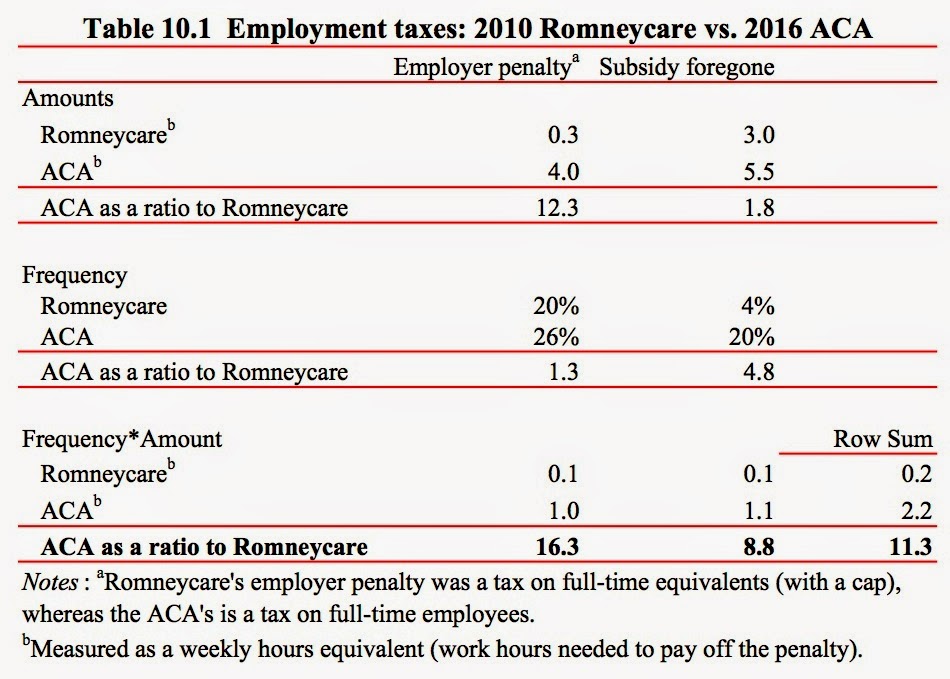
The primary difference between Romneycare and ACA employer penalties is the nominal amount: $ 295 versus $ 2,000 (plus health cost inflation), respectively. Also significant are the facts that the ACA penalty is not business-tax-deductible and that Massachusetts employers are especially likely to offer health insurance even without a penalty.
The subsidized coverage in Massachusetts has barriers to participation that are absent from the ACA and thereby make Romneycare’s implicit [full-time employment tax] less significant. Romneycare came after other permanent forms of assistance for Massachusetts workers leaving [jobs with health coverage], whereas, before the ACA, the federal government had no significant and permanent program for assisting nonelderly nonpoor adults with health insurance while they are not working. Accounting for the prevalence of various taxes, I find that the ACA’s implicit income tax (not shown in Table 10.1) is about eleven times greater than Romneycare’s.

I give the CBO a lot of credit on this. Unlike Professor Krugman, the CBO never fell into the trap of saying that Romneycare= Obamacare, therefore Obamacare has no noticeable effect on the labor market (CBO 2012).

Updated. I answer commenter Veritas with the excerpt below from Chapter 10 of Side Effects.

[The] federal government helped pay for much of Romneycare, whereas the ACA does not turn to any higher power for funding. ...Romneycare encouraged employers in the state to help employees use pre-tax dollars to pay for health insurance, which means that the U.S. Treasury would be passively assisting employees in the form of reduced personal income and payroll tax receipts from Massachusetts. The state also had federal money that was attached to a Medicaid waiver from the federal Department of Health and Human Services (Powell 2012). Thus one should not assume that Romneycare would be elevating Massachusetts labor income tax rates to [the] levels [needed when federal governments expand coverage],

I believe that Professor Gruber videos refer to the Medicaid waiver but, as my excerpt notes, Romneycare had even more federal funding than that.


Wednesday, November 13, 2013

The Slow Death of the Employer Mandate

Copyright, The New York Times Company

Students of health reform can be informed and entertained by revisiting a book by the health reform champion John E. McDonough.

As a member of the Massachusetts House of Representatives from 1985 to 1997, Mr. McDonough had worked for state health reform well before the now famous Romneycare health reform of 2006. During that time he also earned a doctorate in public health.

Like many other former legislators, he wrote a book about his experiences and relationships in office. “Experiencing Politics” (published 13 years ago) organizes his stories around social science models of the political process, including the principal-agent model and punctuated equilibrium theory.

The models are known by fancy phrases in the academic literature, but Mr. McDonough quickly brings them down to earth with explanations that are nontechnical and addressed to the general public. His stories are engaging and bring the models alive, even to social scientists who have seen the models on paper, yet may be dubious that they have much practical value.

Mr. McDonough is not trained as an economist, but usually shows good economic instincts in the book (though he does not mention that per-employee penalties and minimum wages might reduce employment among low-skill workers).

Why is politics so contentious and polarized these days? Mr. McDonough explains that there’s a lot at stake: “We invest enormous authority and trust in our government” and “we give our legislatures remarkable powers to pass laws that govern our own behaviors, from the trivial to the profound.”

Of particular interest today are his Chapters 6 and 7 on Massachusetts health legislation between 1988 and 1997. Mr. McDonough describes how the state’s previous system of hospital rate regulation had been put in place for the purpose of controlling medical spending and how he believes it might have worked for a time.

But he says the academic studies on which he relied became outdated. “I didn’t see it coming,” he says, adding, “Massachusetts government lost the ability to manage its hospital regulatory system with discipline and integrity.” He and other legislators concluded that “market-based contracting, organized around managed care, could correct the worst aspects of market failure, not perfectly but far better than regulation.”

Mr. McDonough describes how Gov. Michael Dukakis’s 1988 law sought to achieve universal coverage in Massachusetts with a legislative package that included a $1,680 penalty (per employee, per year) on employers who did not provide health coverage to their employees. Adjusted for inflation, that would be like proposing a $2,863 penalty in 2006, when Romneycare was passed with a mere $295 employer mandate.

The Dukakis package passed narrowly, and to gain legislative approval the final law delayed the employer mandate’s implementation by four years. Does that sound familiar? The national Affordable Care Act was passed in 2010, with an employer mandate to begin in 2014.

Mr. McDonough describes how those four years gave Massachusetts employers time to organize their opposition. Moreover, as 1992 approached, the Massachusetts labor market was weak. Arguably both of these things happened nationally between 2010 and 2013.

As a legislator, Mr. McDonough met with business executives to respond to their concerns over health reform. He recalls one of those meetings where “sitting quietly through my presentation was the owner of a Domino’s Pizza shop.” The shop owner explained: “I compete against pizza stores that pay everything and everyone under the table. I pay unemployment, worker’s comp, FICA, you name it, and you want to add one more thing that I have to dig up while my competitors pay none of those things? Come on.”

Mr. McDonough had no reply to alleviate that concern. With a few months to go until the originally scheduled implementation, Massachusetts lawmakers decided to delay the Dukakis employer mandate for three years. It would be delayed two more times and then, in exchange for business community support for a coverage expansion for children, ultimately repealed.

On the national level, while Congress was not consulted, with six months to go before the originally scheduled implementation, the Obama administration delayed its employer mandate one year.

Although today Mr. McDonough notes the differences rather than the parallels between the Dukakis law and the Affordable Care Act, proponents of the national employer mandate should be worried that it may be approaching the end of its political life.

Wednesday, November 6, 2013

Two Studies on the Consequences of Romneycare

My paper cited a few studies of the Massachusetts economy before and after Romneycare. Here a few more:


I found that Romneycare increased the Massachusetts marginal tax rate on labor by an average of 0.4 percent points (of total compensation).  From my perspective, I'd expect the Romneycare employment impact to be somewhat smaller than the 0.6% cited above: perhaps 0.2 or 0.3%.

Given that Obamacare increases national average marginal tax rates by about 5 percentage points (about 12 times more than Romneycare did in MA), trying to extrapolate the Massachusetts experience to the ACA -- as many ACA advocates do -- is bold exercise in extrapolation.  But if you absolutely had to extrapolate that way, I'd multiply the Massachusetts results by a factor of something like 12: the ACA's employment impact would be in the -2 to -4 percent range.

Multiplication by twelve is sensitive to all kinds of second order errors like rounding errors and I don't recommend it. We have MUCH better ways of forecasting the ACA's consequences.  Stay tuned for those.

Thursday, September 5, 2013

Curse Words from Professor Gruber

"Because they're the same [bleep]ing bill. [Romney] just can't have his cake and eat it too. Basically, you know, it's the same bill. He can try to draw distinctions and stuff, but he's just [purposely misleading]." Jonathan Gruber compares the ACA to Romneycare, November 2011.

"the Affordable Care Act will, by 2015, add about twelve times more to average marginal labor income tax rates nationwide than the Massachusetts health reform added to average rates in Massachusetts following its 2006 statewide health reform." Casey B. Mulligan, August 2013.


Massachusetts Times 12

Copyright, The New York Times Company

The Affordable Care Act was intended to expand the fraction of the United States population covered by health insurance. The law includes taxes on employers and various implicit taxes on employees that go into effect over the next two years. Economic theory suggests that such taxes will contract the labor market in an amount commensurate with the amount of the new taxes.

The federal government and other advocates of Obamacare have dismissed concerns that the coming labor market contraction would be significant, or even noticeable, by pointing to Massachusetts’s experience with its so-called Romneycare system, also designed to expand insurance coverage. Because the Massachusetts labor market did not noticeably contract relative to the rest of the nation after its system went into effect, an official of the federal Department of Health and Human Services told The Washington Examiner that the experience in Massachusetts suggested “that the health care law will improve the affordability and accessibility of health care without significantly affecting the labor market.”

Prof. David Cutler of Harvard recently addressed, on this blog, concerns about possibly adverse tax effects, saying, “Additional data from Massachusetts, where a state law was the precursor to the Affordable Care Act, suggests that the fears are overblown” and “at this point the evidence overwhelmingly suggests no need for major worry.”

This position assumes that the Massachusetts system increased marginal labor income tax rates in the state by roughly the same magnitude that the Affordable Care Act will increase them in the United States (by marginal labor income tax rate, I mean the extra taxes paid, and subsidies forgone, as the result of working, expressed as a ratio to the total compensation from working). This assumption is no longer necessary, because the methods I have used to measure marginal tax rates from the American Recovery and Reinvestment Act of 2009, unemployment insurance expansions and the Affordable Care Act can also be applied to the Massachusetts health reform law. The results are shown in the chart below.

The left bar shows that the Massachusetts law did, on average, increase marginal tax rates and thereby reduce the reward to working. But the impact was well under one percentage point, and for that reason it’s probably not surprising that, relative to other states that were not experiencing health reform, the Massachusetts labor market did not change noticeably after the law went into effect.

The right bar shows the impact of the Affordable Care Act on nationwide marginal tax rates: it increases national rates about 12 times as much as the Massachusetts law increased rates. Earlier this year I explained why the Massachusetts law was so different from a tax perspective: among other things, its employer penalty is an order of magnitude less, the state’s population is not the same as the national population, and Massachusetts had already been helping unemployed people with health insurance.

It follows that the effect of the Affordable Care Act on employment and work hours would be roughly 12 times as great as the effect of the Massachusetts law. That doesn’t by itself tell us the exact impact of the national law because we don’t have a precise estimate of the impact in Massachusetts, except that it was small. For example, if the Massachusetts law reduced employment by 0.1 percent, the Affordable Care Act’s effect would be roughly 1.2 percent; not small. If the Massachusetts law’s effect were 0.25 percent (still small), the Affordable Care Act’s effect would be 3 percent: again, not small. The bottom line was that it was wrong to expect the two laws to have had the same effects.

Call me gloomy, but I’m one economist who thinks that adding, on average, five percentage points to marginal tax rates will noticeably depress the labor market, while adding a few tenths of a point in Massachusetts did not.


Thursday, August 29, 2013

Is the Affordable Care Act Different from Romneycare? A Labor Economics Perspective

            The Affordable Care Act was designed to expand the fraction of the population covered by health insurance.  The act (hereafter, ACA) includes taxes on employers and various implicit taxes on employees that go into effect over the next two years.  Economic theory suggests that such taxes would contract the labor market in an amount commensurate with the amount of the new taxes.
            The federal government and other advocates of the Affordable Care Act have dismissed concerns that the coming labor market contraction would be significant, or even noticeable, by pointing to Massachusetts’ experience with a reform also designed to expand insurance coverage (hereafter, Romneycare).  Because the Massachusetts labor market did not noticeably contract relative to the rest of the nation after Romneycare went into effect (Dubay, Long and Lawton 2012), the U.S. Department of Health and Human Services said “The experience in Massachusetts … suggest[s] that the health care law will improve the affordability and accessibility of health care without significantly affecting the labor market” (Contorno 2013).  As Jonathan Gruber put it, “We’ve actually run this experiment, folks: we ran it in Massachusetts” (Gruber 2011, 27:02).[1]
            This paper assumes for the sake of argument that forecasts of the employment and work hours effects of the Affordable Care Act ought to rely on, among other things, an examination of Romneycare and Massachusetts’ labor market activity surrounding its implementation.[2]  However, in doing so it is worthwhile assessing the direction and magnitude of the incentives created by both reforms, and to do so with a common methodology.  This paper makes such an assessment, drawing on a companion paper (Mulligan 2013) that reports more details on the methodology and results for the ACA by itself.
            The Massachusetts reform, passed in 2006 and implemented over the subsequent two years (Dubay, Long and Lawton 2012), specified that state residents must have health insurance, or potentially face a monetary penalty.  It created a couple of health plans with means-tested subsidized premiums.  The reform also penalized employers for not providing health insurance for enough of its employees, with the penalty amount linked to the number of employees on the payroll.  Roughly speaking, the nationwide ACA has the same three elements, which will take effect over the next two years.
        The tax rate effects of Romneycare are in various directions.  In combination, they raised marginal tax rates in 2010 by less than one half of one percentage point relative to what they would have been without Romneycare.  The ACA adds about 4.9 percentage points to marginal tax rates: about twelve times Romneycare’s addition.
       The results account for the fact that many people will not participate in programs for which they are eligible, the tendency of the act to move people off of means-tested uncompensated care, and the fact that Romneycare implicitly taxes unemployment benefits.  Although parts of Romneycare builds “notches” and “cliffs” into household budget sets – that is, infinitesimal income intervals over which marginal tax rates are infinite – my quantitative results are not a consequence of those notches or cliffs.


[1] See also the Urban Institute study concluding that “the broad similarities between the ACA and Massachusetts’ reform suggest that we can expect to see patterns in the response by employers under the ACA similar to those observed under health reform in Massachusetts” and that “the evidence from Massachusetts would suggest that national health reform does not imply job loss and stymied economic growth.”  (Dubay, Long and Lawton 2012)
[2] I use “Romneycare” to refer to the MA health law as implemented after 2006 (with special emphasis on 2010), regardless of whether the implementation details were determined under the governorship of Mitt Romney or Duval Patrick, who took office in early 2007.

Wednesday, May 22, 2013

Massachusetts Employees Will Keep Their Health Plans

Copyright, The New York Times Company

Massachusetts and a few neighboring states are likely to experience the Affordable Care Act a lot differently than the rest of America.

Massachusetts is often held up as a window into America’s health insurance future, because it embarked on what came to be called the Romneycare reform six years ago. Like the Affordable Care Act provisions going into effect nationwide next year, Romneycare aimed to increase the fraction of the population with health insurance by imposing mandates on employers and employees and by subsidizing health insurance plans for middle-class families without employer plans.

Because the subsidized plans are available for only low- and middle-income families whose employers do not offer affordable health benefits, some analysts fear employers around the nation will drop their health benefits as the Affordable Care Act goes into full effect, resulting in millions of people losing the opportunity to get health insurance through an employer.

But some people say they believe this fear is likely to be unfounded, because the propensity of Massachusetts employees to receive employer-sponsored health insurance was hardly different after Romneycare went into effect than it was in the years before.

The details and dollar amounts in the Massachusetts health care law differ from the national Affordable Care Act, and for that reason alone I hesitate to infer too much from the Massachusetts experience. Even if the two laws were essentially the same, the effects in Massachusetts could be different than the national effects because Massachusetts has a different population and business environment than the rest of the nation.

Last week I explained how specific types of employers could be expected to drop their health benefits during the next couple of years: those employers that currently offer benefits but nonetheless pay much of their payroll to people living in households below 300 percent of the federal poverty line, who are eligible for the most generous federal subsidies as soon as their employer ceases to offer benefits.

Massachusetts has an extraordinary fraction (almost two-thirds) of its population above 300 percent of the federal poverty line, and as a result practically all Massachusetts employers will prefer to retain their health benefits over the next few years, even though a significant fraction of employers elsewhere will not.

One way to quantify the difference between Massachusetts employers and employers elsewhere is in the percentage of payroll going to employees from families below 300 percent of the poverty line. At a national level, the percentage varies from 4 percent in Internet publishing to about 50 percent in restaurants and private household employers. The national average is 20 percent, compared with 13 percent in Massachusetts.

Employers have a variety of factors to consider in their benefit offering decisions, but I have made some estimates that focus on the payroll-composition statistics noted above. By my estimates, employers with percentages of 26 to 35 percent of employees above 300 percent of the poverty level have a sufficiently high percentage that they are likely to have been offering health insurance benefits before the Affordable Care Act. Yet they have a low enough percentage that their employees gain on average if the employer health benefit is dropped and employees take the subsidies available through the Affordable Care Act’s health insurance exchanges.

About 10 percent of employees with health insurance live in a state and work in an industry with compensation percentages in the range where profits are to be gained by dropping employer health insurance. But none of them live in Massachusetts, and some states that border Massachusetts, including New Hampshire and Connecticut, are in a similar situation.

A number of states and industries – especially the industries I emphasized last week – have more than 35 percent of their payroll paid to people in families under 300 percent of the poverty line and are unlikely to be offering employee health benefits.

But those employers in Massachusetts who have 35 percent of their payroll paid to people in families under 300 percent of the poverty line are more likely to offer some kind of health benefit, in part because of Romneycare’s incentives to create “cafeteria plans” in which employees authorize pretax salary to be withheld from their paychecks for the payment of health insurance premiums.

Under the federal law, the Massachusetts cafeteria plans will lose some of their advantages to employers in terms of avoiding penalties for failure to offer health benefits.

Based on the combination of these two factors — that no Massachusetts industries have 26 percent to 35 percent of their employees under 300 percent of the poverty line, and that Massachusetts employers will lose the advantages of their cafeteria plans — I calculate that employers offering health insurance in Massachusetts are one-third as likely to drop their employee health plans over the next couple of years as are employers in the rest of the nation.

That’s because the percentage of the United States work force at risk of losing its employer insurance (because of the tendencies of their industry and states to have low- and middle income employees) is three times the percentage of the Massachusetts work force in the same situation.

Thursday, May 9, 2013

Romneycare, Obamacare, and the Labor Market

Conventional wisdom says that we can make a good guess about the post-2013 labor market impacts of Obamacare just by looking at the post-2006 performance of the Massachusetts labor market as it began its state-level health reform (Romneycare).

If there were another country or region that had already tried Obamacare, we would learn a lot from the results. However, even though Obamacare and Romneycare are both forms of “health reform,” and both seek to reduce the number of people without health insurance, they are quite different in terms of the types and amount of labor-market incentives they create.

The conventional wisdom is incorrect because it ignores these fundamental differences:

  1. Obamacare is designed to subsidize high quality insurance plans for middle class people -- plans good enough for your U.S. Senator.  Romneycare only subsidized Medicaid Managed Plans with benefits of far less value than the typical employer health plan.
  2. Under Obamacare, middle-class families can get subsidized health insurance for their entire family, including their children.  As noted above, those plans are good enough for their Senator.  Under Romneycare, the new subsidized plans were for adults only; families wanting subsidized insurance for their children had to apply for Medicaid.
  3. For the first time under Obamacare (with a brief exception under the American Recovery and Reinvestment Act), most workers outside of Massachusetts will obtain health insurance subsidies only by leaving their job or getting fired -- the economic equivalent of unemployment assistance.  Romneycare did not introduce health insurance subsidies for the unemployed in Massachusetts, because the state has had such subsidies in place since the 1980s.
  4. Under Obamacare, middle-class persons leaving a job with health insurance are immediately eligible for subsidized health insurance.  Under Romneycare, there is a six month waiting period, and even then only if the persons do not qualify for Medicaid.
  5. Both Obamacare and Romneycare have per-employee penalties for employers not offering insurance but, accounting for the business tax treatment of those penalties, the Obamacare penalties are more than ten times larger.
  6. Romneycare was designed to leverage the special federal tax treatment of employer-provided fringe benefits.  Obamacare is designed to reduce the usage of that special federal tax treatment.
  7. Romneycare subsidies exclude families between 300% and 400% of the federal poverty line.  Obamacare subsidies do not.  Even if the two reforms had the same income cutoff, a larger fraction of Massachusetts would be above it because Massachusetts is a high income state.
  8. Employer-provided insurance was a lot more prevalent in Massachusetts before Romneycare than it is in the U.S. generally.  ie., even if we ignore the penalty amounts and subsidy values, the fraction of the U.S. labor market directly experiencing the Obamacare penalties and subsidies will far exceed the fraction of the Massachusetts population experiencing Romneycare penalties and subsidies. 

The combined difference between Romneycare and Obamacare is greater than the sum of the individual differences noted above, for the simple reason that the total incentive created by new programs is the product of takeup, eligibility, and the value of subsidies to each participant.

As a result of these differences, Obamacare does a lot more to encourage employers to drop insurance.  Under Romneycare, dropping employer coverage amounts to telling employees "It's time for your children to go on Medicaid, and for you to go on a Medicaid Managed Plan, and you probably won't use your family doctor anymore."  Under Obamacare, employees will be told "You can join the same health plan as your Senator AND save money."

Obamacare creates a massive new implicit tax on work.  Romneycare probably created a new implicit tax, but, for the reasons noted above, the Obamacare implicit tax will be one or two orders of magnitude greater.


To learn more about Romneycare, take a look at the book The Great Experiment.

Thursday, March 14, 2013

ACA Forecasts Have Not Yet Been Grounded in Microeconomics

The Congressional Budget Office, Jonathan Gruber and others attempting to forecast the effect of the Affordable Care Act (ACA) on the propensity of employers to offer health insurance have gotten the microeconomics wrong.

Background: Beginning in 2014, employers who offer affordable health insurance will thereby render their employees ineligible for health insurance tax credits that can be large as $15,000 per family per year. All analysts agree that there are SOME employers who will react to this situation by dropping their coverage, and that their employees will benefit by obtaining the subsidies. The debate is about the size of this effect and whether it would large enough to offset other factors that might be encouraging employers to offer coverage.

In one way or another, the answer to the question is ultimately found through empirical analysis. One could wait until say, 2015, and measure what happened. For those of us who want a forecast before then, we must somehow relate historical episodes to what the ACA will do in 2014.

The approach of CBO, Professor Gruber (see 27:02 in this video), and others has been to (a) think of a "demand" for employer-sponsored insurance (hereafter, ESI) and (b) look at the historical sensitivity of that demand to the price of ESI, especially variation associated with the ESI subsidy implicit in the exclusion of ESI premiums from payroll taxes and employee income taxes. Item (b) is acceptable enough -- I agree that subsidies impact prices -- but item (a) is fundamentally flawed because the wrong demand curve has been identified.

Historically, there has not been a viable non-group insurance market, so that employers dropping their coverage are in effect asking a significant fraction of their employees to go uninsured or to apply for Medicaid. The demand curves traced out by such episodes are telling us about the distribution of employee preferences for being uninsured (or on Medicaid) and the distribution of ESI administration costs (broadly defined to include insurance loadings and other factors). Economic theory does not tell us the precise shape of these distributions, so it's nice to have examined the historical episodes, which suggest that the elasticity of the propensity to offer ESI with respect to the price of ESI is roughly -0.5. In other words, historical increases in ESI prices in the amount of 10% have caused roughly 5% of employers to drop coverage.

But, under the ACA, dropping ESI does not mean leaving the employees uninsured. The propensity of employers to drop ESI under the ACA therefore has little to do with the distribution of employee preferences for being uninsured or for participating in Medicaid. Thus, to a first approximation, the -0.5 elasticity cited above is irrelevant. (More precisely, the magnitude of the historical elasticity is probably a conservative lower bound on the magnitude of the elasticity relevant for ACA forecasts, because going uninsured is a feasible but unlikely choice for employees who lose ESI).

What we really need to know is the distribution of employee preferences to participate in the ACA's "exchange" plans, and the distribution of ESI administration costs as compared to exchange administration costs (again, broadly interpreted to include insurance loadings, etc.). Health economists have not studied that yet.

You might think that the distribution of ESI administration costs would be relevant for the ESI-exchange margin, but the exchanges will have administrative costs too. The application for exchange plans is 21 pages long: employers who drop ESI may well replace it by helping their employees with application and other administrative tasks, much like employers help employees with immigration paperwork. From this perspective, ESI and exchange participation look like very close substitutes and the 0.5 price elasticity magnitude looks like a wild underestimate.

Although the exchange plans will not be called "Medicaid," you might think that the distribution of preferences for Medicaid participation could be important because people will attach some of the same stigma to exchange participation as they do to Medicaid. I would agree with you if the purpose was to quantify the effect of Massachusetts' health reform on ESI coverage, because premium support was made available in Massachusetts primarily through its "Commonwealth Care" program which was a collection of 4 Medicaid managed plans (one plan has been added since). In contrast, recipients of federal ACA subsidies will be receiving cash they can spend on a plan of their choice, one or two of which will be the plans in which their state's U.S. Senators are enrolled: that’s a lot closer substitute for ESI than Medicaid is.

Because they have helped uncover distributions of administration costs and preferences for being uninsured, the historical studies are better suited to predict the number of people who will change from uninsured to insured as a consequence of the ACA, as RAND has done. But that's very different from predicting how many people move from ESI to non-group policies. Even without considering labor-market equilibrium effects or general equilibrium effects of the ACA on ESI coverage, we can already see that demand analysis has been misapplied in ACA forecasting and that the propensity of the ACA to reduce ESI coverage has been underestimated.

Wednesday, March 6, 2013

Health Reform, the Reward to Work and Massachusetts

Copyright, The New York Times Company

The United States labor market is in for a shock when health reform is fully carried out, regardless of what employers decide about health insurance or how smoothly reform might have unfolded in Massachusetts.

Beginning next year, millions of Americans will be eligible for generous subsidies in the form of cash assistance to pay for their health insurance premiums and out-of-pocket health expenses pursuant to the Affordable Care Act. The subsidies will sharply reduce the financial reward to working because they will be phased out with household income.

As the Princeton economists Alan B. Krueger, who has held positions in the Obama administration, and Uwe E. Reinhardt, my Economix colleague, explain, health insurance premium assistance “would present millions of low-income American families with total marginal tax rates in excess of 75 percent.” They add, “Such high marginal tax rates may well make unemployment and welfare an attractive alternative to working.”

It would appear that, together with per-employee penalties levied on employers, the new law’s health insurance subsidies could significantly affect the labor market.

Most workers are offered affordable health insurance by their employers, and the new law will consider them ineligible for subsidies and will not ask their employers to pay any penalty. You might guess that the aggregate labor-market impact of the law could be small, because the penalties and subsidies would not apply to the majority of the work force “covered” by employer health insurance.

But it is wrong to assume that the law will have little effect on the reward to working among covered workers. Their employers could drop coverage, or the employee could switch to a job without coverage. More important, the subsidies are available to the unemployed and others who do not work, even if their previous jobs had provided coverage. If and when they go back to work in a covered job, federal law will welcome their return by taking their subsidy away.

Yet another reason that covered workers will experience high marginal tax rates like those noted by Professors Krueger and Reinhardt is that the subsidies will be available to family members on the basis of the employee’s income, in combination with his or her spouse’s income, if any.

The Department of Health and Human Services says there is no reason for alarm because the experience in Massachusetts since 2006 shows “that the health care law will improve the affordability and accessibility of health care without significantly affecting the labor market,” as I noted last week, referring to a Washington Examiner report.

For those worried about dire labor market consequences of the federal law, Jonathan Gruber of the Massachusetts Institute of Technology replies (at 27:32 in this video): “We’ve actually run this experiment, folks, we ran it in Massachusetts. O.K. In Massachusetts, we put in a system with more generous subsidies than the federal government is doing.”

When it comes to quantifying the new federal law’s penalty on employment, Professor Gruber and Health and Human Services are incorrect to take comfort in the Massachusetts experience since 2006. As I explained last week, the federal law’s employer penalty is more than tenfold the Massachusetts penalty. In other words, if the Massachusetts penalties pushed down workers’ wages by 16 cents an hour, the federal penalties would push them down $1.67.

Professor Gruber is also incorrect that the federal law is introducing less generous subsidies than the Massachusetts law did. Federal subsidies will be available for people laid off from their jobs, but the new Commonwealth Care subsidies in Massachusetts are not, because Commonwealth Care excludes people eligible for the Medical Security Program (a longstanding program providing health benefits to Massachusetts people receiving cash unemployment benefits).

Moreover, people leaving a job with health insurance have to wait six months before they can enter Commonwealth Care.

Commonwealth Care also excludes children: if a Massachusetts resident wants health insurance subsidies for his or her children, Medicaid is the primary option. The federal law has no such restriction: it allows Americans to receive subsidies while enrolling their entire families in the same health plan as, say, the United States senators representing their states.

Indeed, many consumers may perceive Commonwealth Care to be an extension of Medicaid. When it began, Commonwealth Care consisted of four plans offered by the state’s Medicaid Managed Care Organizations (a fifth plan has recently been added). Perhaps that’s why only 158,000 people were enrolled in Commonwealth Care as of 2011, which is less than 10 percent of the people in Massachusetts whose family income fell in the interval required by the program.

In contrast, recipients of federal subsidies will be receiving cash they can spend on a plan of their choice: that’s a lot more generous than helping people join Medicaid.

For all these reasons, economic reasoning points to a contraction of the United States labor market as the full Affordable Care Act is carried out, regardless of what may have happened in Massachusetts.

Wednesday, February 27, 2013

In Massachusetts We Trust

Copyright, The New York Times Company

watch a minute or so of this clip.


From a labor-market perspective, the Affordable Care Act has little in common with the 2006 health reform law implemented in Massachusetts.

Some employers are complaining about the $2,000 per-employee-per-year penalty they will pay beginning next year when the main provisions of the Affordable Care Act go into effect. The Congressional Budget Office also warned about the astonishing increase in marginal tax rates that middle-income Americans will experience, because the additional income earned by a family will be considered by the Internal Revenue Service as available for additional health insurance payments.

One might guess that large changes like these would shock the nation’s labor markets, especially the markets for less-skilled workers for whom $2,000 is a significant sum, not to mention the costs of health insurance.

The United States Department of Health and Human Services rejects these concerns, saying that the experience in Massachusetts suggests “that the health care law will improve the affordability and accessibility of health care without significantly affecting the labor market,” The Washington Examiner reported. The Urban Institute also thinks the Massachusetts results will accurately model the national market.

If there were another country or region that had already tried the federal Affordable Care Act, we would learn a lot from the results, regardless of how much business people might be complaining. However, even though the Affordable Care Act and the Massachusetts law are both forms of “health reform,” and both seek to reduce the number of people without health insurance, they are quite different in terms of the labor-market incentives they create.

One of several unique features of the Massachusetts law is that it attempts to leverage the exclusion of employer-provided health insurance from federal personal income tax for the purpose of getting insurance to the previously uninsured. The law encouraged employers to set up a “125 plan” that allows employees to use their own pretax dollars to buy health insurance.

Under a 125 plan, an employer need not pay for employee health insurance: the employer only assists a bit in the administration of the premium payments and withholding. The premium payments themselves come from employee paychecks. And the 125 plans are for employees (who may buy insurance on behalf of their families), not for people without jobs.

Even before the law was passed, Massachusetts employers typically offered some kind of health insurance plan to employees. The state law pushed a significant fraction of the remaining few to try the 125 approach by threatening to bill noncompliant employers for the uncompensated care their employees received around the state, a penalty known as the “free-rider surcharge.” So far, studies have found that enough employers took on 125 plans that ultimately no employers were liable for the surcharge.

In contrast, the federal Affordable Care Act attempts to nudge the national labor market away from the federal tax exclusion for employer-provided insurance by offering large subsidies only to people who are not part of an employer plan, including people who are not employed. The act also passes judgment on the affordability of employer plans and penalizes employers who offer “unaffordable” plans and then have employees who receive the subsidies. The federal penalties can reach $3,000 per employee and are not deductible from business taxes.

As long as they do something like the 125 plan to help their employees use the federal tax exclusion, Massachusetts employers are only nominally responsible for the “affordability” of health insurance or for failures of their employees to take advantage of the plan offered. The Massachusetts penalty is only $295 per employee-year (as far as I can tell, it is business tax-deductible, which makes the $295 less than one-tenth of the federal penalty); it can be avoided by an employer that makes nominal contributions to its employees’ premiums and induces enough employees to participate.

Perhaps it’s wise for the Affordable Care Act to push in a different direction than Massachusetts did, because many economists think the federal personal income tax exclusion promotes health care inefficiencies and diverts much-needed revenue from the United States Treasury.

But that wisdom doesn’t change the fact that the federal law will put very different pressures on employers and employees than the Massachusetts law does. It would be unwise to assume that next year’s national labor market will follow the patterns that the labor market in Massachusetts experienced after 2006.


More differences will be noted in future posts. Take a look at these, especially the video debate linked from the second one.

Does Massachusetts Predict Employer Behavior Under Obamacare? Probably Not: Part 1

Part 2: Does Massachusetts Predict Employer Behavior Under Obamacare? Probably Not