Wednesday, August 29, 2012

Is the Fiscal Cliff a Big Deal?

Copyright, The New York Times Company

With their Keynesian analysis, the Congressional Budget Office and others have exaggerated the effects of the “fiscal cliff” on the labor market and the economy.

Come January, current law provides for significant cuts in federal spending and for tax increases – and thereby significant federal budget-deficit reduction. These provisions have been collectively described as the “fiscal cliff,” which emerged when Democratic and Republican leaders could not agree on plans on spending and taxes.

The Congressional Budget Office has warned that the fiscal cliff will cause a double-dip recession, but its analysis for 2013 is based on the Keynesian proposition that anything that shrinks the federal budget deficit shrinks the economy, and the more the deficit is reduced the more the economy is reduced.

In many circumstances, the Keynesian proposition reaches the wrong conclusions about economic activity, because deficits do not necessarily expand the economy or prevent it from shrinking. For example, reducing the deficit by cutting unemployment insurance – it’s one of the programs that would be cut in January – would shrink the economy in the C.B.O.’s view.

But in reality, cutting unemployment insurance would increase employment, as it would end payments for people who fail to find work and would reduce the cushion provided after layoffs.

Helping people who are out of work may be intrinsically valuable because it’s the right thing to do, but the Congressional Budget Office is incorrect to conclude that it also grows the economy or prevents it from shrinking. Paying people for not working is no way to put them to work.

The Keynesian proposition about budget deficits ignores incentives of all kinds, so its incorrect conclusions about the fiscal cliff are not limited to unemployment insurance. Another example: the fiscal cliff would put millions of Americans on the alternative minimum tax, which Keynesian analysis said would shrink the economy solely because it collected more revenue.

Yet economists who have studied the alternative minimum tax have found that its effects on incentives to work and produce are essentially neutral, compared with the ordinary federal personal income tax.

(The Congressional Budget Office does not use pure Keynesian analysis for its long-term projections, which include labor-supply incentive effects of tax rates, but apparently has decided that incentives’ effects can be safely neglected in the short term.)

None of this implies that the fiscal cliff will expand the economy, because some of its provisions will increase the penalties for working and producing.

The fiscal cliff would cut Medicare payments to doctors by 2 percent, which reduces doctors’ reward for treating Medicare patients. This may cause doctors to work less (or to work more for non-Medicare patients). The fiscal cliff would end the “Bush tax cuts” provisions, some of which have been enhancing the incentive to work (but beware – not all laws labeled “tax cuts” enhance incentives).

Perhaps the incentive-reducing provisions of the fiscal cliff outweigh its incentive-enhancing provisions, in which case the Congressional Budget Office has arrived at approximately the right answer for the wrong reasons.

But even in that lucky case, the C.B.O.’s quantitative estimates of the fiscal cliff’s economic effects are not reliable until they fully incorporate economic incentives.

Wednesday, August 22, 2012

Is Deficit Spending the Answer?

Copyright, The New York Times Company

Deficit spending comes in several different flavors, each of which varies in terms of its effect on the labor market and the economy.

Deficit spending occurs when government spending exceeds government revenue. By official estimates, the federal government budget deficit has been $1.3 trillion during each of the last three fiscal years and even larger the year before that, when the financial crisis and bailouts were at their peaks. Previously, the federal deficit had never reached $0.5 trillion.

The alternatives to deficit spending are a balanced budget or a surplus budget, when government revenue is at least as much as its spending.

Economists do not fully agree about the macroeconomic effects of deficit spending, compared with the balanced-budget alternative, but they do agree that not all deficit spending is the same. Deficit spending that is the result of extra government spending is different from deficits that come from tax cuts. Moreover, the forms of the extra spending matter, as do the forms of the tax cuts and how the debt will be repaid in the future.


One form of deficit spending is extra government employment (civilian or military), as during wartime, paid for with extra taxes after the war is over. This type of spending probably increases aggregate employment during the war because the government is paying people to work and, while the deficit spending lasts, not yet taxing them extra for working.

This type of deficit spending is relevant today, because America continues to fight wars in the Middle East and to fight the war on drugs in our hemisphere. However, this type is not much different during the last four years of trillion-plus deficits than it was before.

The more important source of enlarged federal deficits is increased spending on transfers, like food stamps and unemployment insurance, and in-kind subsidies for the poor, like Medicaid. Transfer spending helps poor people, but paying people for low incomes or for unemployment has the effect of reducing the reward to work, rather than increasing it as government employment programs might.

By considering work incentives, I conclude that the contribution of transfer spending to the deficits of the last four years have reduced employment, rather than increasing it as wartime deficits might.

The temporary payroll tax cut has also added to the government deficit over the last two years. The payroll tax is levied on people who work and not on people who are out of work, so the cut had the effect of reducing the tax penalty on work. This helped offset the employment-depressing effect of transfers, although my estimates suggest that the offset was less than 100 percent (more on those in future blog entries).

Deficit spending adds to the government debt, because the government has to borrow to obtain the funds it does not have from taxes. It is sometimes argued that deficit spending reduces employment because of fears over the future repayment of the debt. But future fears can also encourage people to work harder to save more for the bad economic situation that is anticipated in the future and to work harder to take advantage of today’s tax rates, which might seem low compared with what lies ahead.

Moreover, the bond market pays dearly for United States government bonds: they may be the most expensive bonds (that is, the bonds with the lowest yields) in the world. If the market continues to value United States government bonds so dearly, much of the United States debt may never need to be paid off.

This may seem like a free lunch, but economists understand it as a “liquidity service,” or feeling of safety that the government supplies to the marketplace for which the government is compensated (Milton Friedman’s classic argument said low yields on government securities indicate that more of the securities should be supplied to the market).

The secret to understanding the effects of deficit spending on the labor market and the economy is to examine the incentives created by the additional spending and by tax cuts.

Wednesday, August 15, 2012

Trickle-down Fairy Dust

Copyright, The New York Times Company

Generally, transfers do not expand the economy, regardless of whether the recipients are rich or poor. Rather, they confer benefits that are limited to the direct recipients of those transfers.

President Obama recently denigrated the Romney-Ryan economic plan by saying the Republican candidates believe that if Congress gave “more tax breaks to the wealthiest Americans, it will lead to jobs and prosperity for everyone else.” He called that approach “trickle-down fairy dust.”

The trickle-down theory says that a policy benefiting a specific group, like the wealthiest Americans, will somehow confer benefits on everyone else. One common version of this view is that the benefiting group increases its spending, which in turn benefits the industries whose products are purchased with such additional spending, perhaps leading to the hiring of more workers to meet the increased demand.

The Obama administration has its own version of this — what we might call trickle-up — which says that policies benefiting unemployed people even help people who are not unemployed, because the unemployed react to their government benefits by spending more.

Both of these views are flawed for two reasons. First, the transfer of resources from one group to another probably does not increase aggregate spending (if incentives are held constant), because we have to consider both the spending of the receiving group and the spending of the group that finances the benefits through tax payments or loans to the government.

Transfers may change the composition of spending to the extent that the benefiting group spends its resources differently than the financing group. Cutting taxes on the rich and raising them on the poor would probably, holding incentives constant, increase spending on fancy restaurants, investment goods and yachts, and decrease spending on, say, groceries and cellphones.

The altered composition of spending can have some interesting, but probably small, effects on the labor market, depending on the labor intensity of the various industries involved (as I noted in a previous post). But changing the composition of spending is not the same as changing the total.

Few transfer programs hold incentives constant. Unemployment insurance reduces the incentive to find work and (especially when it is federally financed) reduces the incentive for businesses to avoid layoffs, and in this way reduces aggregate spending. Sometimes so-called tax cuts and tax credits can reduce spending by discouraging work and redirecting economic activity to less-productive uses.

Even if a transfer from one group to another did increase aggregate spending and output, the second flaw of trickle-down theory is that the additional spending confers benefits beyond the direct beneficiaries of a transfer.

You might think that more spending on, say, groceries would benefit grocers and the farmers who supply them. It’s true that a grocer receives funds when a new customer comes to his register. But he also has to provide more groceries or have one of his other customers get by with fewer groceries, and groceries are not free to supply. The funds a seller receives from a new customer may just offset the total costs of the goods provided to the customer, so the seller is hardly better off.

A more nuanced analysis might assume that customers are normally charged more than cost (broadly defined) for the goods they receive, so that sellers are a little better off when aggregate spending increases. It might also consider that some industries are subject to economies of scale, so that other customers are better off when a new customer enters the market. Industries (and the workers they employ) sometimes pay more taxes when they expand, so the public treasury benefits when there’s more aggregate spending (the so-called Laffer curve is a special case).

None of this implies that a good public policy cannot transfer from one group to another. Transfers may intrinsically be good: we may enjoy helping the poor or value the freedom associated with limited taxation. Or the direct beneficiaries from redistribution may gain much more than the rest of us lose.

But until we know more about the magnitude of the second- and third-round effects of transfers on people who do not receive them, redistribution cannot be justified as helping those who finance it.

Monday, August 13, 2012

Quiet Time at Supply and Demand

The blog has been quiet for the last couple of months -- not even copies of my weekly economix posts. Loyal readers, please accept my apologies. I have been very busy finishing my book.


I hope and expect that the book will offer you more enjoyable and user-friendly reading about supply and demand than the blog posts it displaced. Once the book is out I can return to more frequent blogging and solicit your opinions on the next book!

Wednesday, August 1, 2012

Food Stamps: Married People Need Not Apply

Copyright, The New York Times Company

A fundamental difference between unemployment compensation and the food stamp program is their treatment of household income. The result is that food stamp participation among married people is relatively rare.

Traditionally, the food stamp program (now called SNAP) was for the poor: participants had to demonstrate that their incomes and assets were both low, and the program was financed out of general revenue. Unemployment compensation was an insurance program, financed from contributions by participating workers and awarded regardless of one’s assets or the earnings of other household members.

Today, the programs have converged in many ways. Much unemployment compensation (namely, the extended and emergency payments made to people whose unemployment has lasted more than 26 weeks) is financed by the federal government. Most states admit participants into SNAP using “broad-based categorical eligibility,” which (with the exception of three states) means that assets are not checked. For a few years unemployment benefits were available even for those who had been collecting for almost two years; food stamp participation can continue indefinitely.

But an important difference between SNAP and unemployment compensation has remained throughout the recession: the SNAP program checks the income of all household members and bases eligibility on the entire household’s income, not just the situation of the household head.

Naturally, children do not earn much income, so the practical result of the household income rule is that participation in SNAP among the unemployed depends very much on marital status. An unmarried, unemployed household head may have children in the family, but by definition has no spouse, and thereby is unlikely to have much additional family income.

In contrast, an unemployed person with a spouse earning, say, $30,000 a year, has little chance of participating in SNAP because the spouse’s income alone would most likely disqualify the entire household.

The chart below shows program participation rates among unmarried household heads. Using Census Bureau data, I identified household heads and spouses who experienced some unemployment during calendar year 2010 and classified them by their wages and salaries for the year. SNAP participation depends on income relative to household size – larger households need more food and therefore can participate in the program at somewhat higher incomes – so I expressed each person’s wages and salaries relative to the federal poverty guideline for households their size. For example, a value of 1 on the chart’s horizontal axis represents people whose wages and salaries were equal to the federal poverty guideline for their household, which was $22,050 for a family of four.

The red line in the chart is SNAP participation rates for unmarried people relative to married people. The blue line is unemployment insurance receipt for unmarried people relative to married people. For example, for household heads and spouses experiencing unemployment and earning no wage or salary income in 2010, the rate of receiving unemployment insurance was about the same for married and unmarried people: a participation rates ratio of about 0.9. But the SNAP participation rate was twice as great among the unmarried.

For the other earnings categories, unmarried SNAP participation rates range from 1.5 to 2.5 times what they are for married people.

The bottom line is that SNAP is largely a program with unmarried participants. SNAP may be an effective way of feeding people, but its low participation among married people may make it politically less popular than unemployment compensation.

Thursday, July 26, 2012

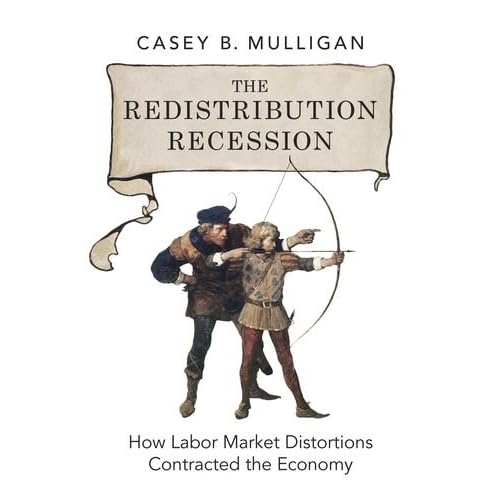
Pre-order your copies of The Redistribution Recession


In the next several days I will be reviewing the page proofs of my forthcoming book The Redistribution Recession.

You can pre-order a hard cover version with color charts, including shipping, for less than $35!! That's so cheap that you'll want to order one for home and another for the office.

Amazon.com

Barnes and Noble

Redistribution, or subsidies and regulations intended to help the poor, unemployed, and financially distressed, have changed in many ways since the onset of the recent financial crisis. The unemployed, for instance, can collect benefits longer and can receive bonuses, health subsidies, and tax deductions, and millions more people have became eligible for food stamps.

Economist Casey B. Mulligan argues that while many of these changes were intended to help people endure economic events and boost the economy, they had the unintended consequence of deepening-if not causing-the recession. By dulling incentives for people to maintain their own living standards, redistribution created employment losses according to age, skill, and family composition. Mulligan explains how elevated tax rates and binding minimum-wage laws reduced labor usage, consumption, and investment, and how they increased labor productivity. He points to entire industries that slashed payrolls while experiencing little or no decline in production or revenue, documenting the disconnect between employment and production that occurred during the recession. The book provides an authoritative, comprehensive economic analysis of the marginal tax rates implicit in public and private sector subsidy programs, and uses quantitative measures of incentives to work and their changes over time since 2007 to illustrate production and employment patterns. It reveals the startling amount of work incentives eroded by the labyrinth of new and existing social safety net program rules, and, using prior results from labor economics and public finance, estimates that the labor market contracted two to three times more than it would have if redistribution policies had remained constant.

In The Redistribution Recession, Casey B. Mulligan offers hard evidence to contradict the notion that work incentives suddenly stop mattering during a recession or when interest rates approach zero, and offers groundbreaking interpretations and precise explanations of the interplay between unemployment and financial markets.

I understand that physical copies are scheduled to ship from the press' warehouse on October 4 ... a week or two after that, the book should be available for immediate purchase.

Wednesday, July 25, 2012

Who Cares about Fed Funds?

Copyright, The New York Times Company

New research confirms that the Federal Reserve’s monetary policy has little effect on a number of financial markets, let alone the wider economy.

Politicians, and a few economists, have been imploring the Federal Reserve to help the economy grow before November. But the effects of monetary policy on the wider economy are small.

The Federal Reserve and especially its regional bank in New York are actively engaged in buying and selling Treasury securities, and the Fed lends money to banks. These transactions influence the rate charged on overnight loans among banks, which is known as the federal funds rate.

Because interest rates are important to homeowners and businesses, it is tempting to conclude that the Federal Reserve affects the economy by affecting interest rates. But the federal funds rate is only one of many interest rates in the economy, and it is those other interest rates that households and nonbank businesses pay as borrowers and receive as lenders.

Yet a few economists have concluded that today’s exceptionally low interest rates on federal funds have turned our economy upside down, so that policies like unemployment insurance that pay people for not working these days actually get people back to work.


A 1983 study by Lars Peter Hansen of the University of Chicago and Kenneth Singleton of Stanford showed that short-term rates on Treasury bills and short-term returns on stocks traded on the New York Stock Exchange had very little correlation with consumer spending. Many empirical studies have confirmed this sort of result (this comparison of inflation-adjusted Treasury bill returns and business sector profitability is a recent example).

Nevertheless, a few economists working on the relationship between short-term interest rates and the economy still assume that consumer spending closely follows those rates (see, for example, the bottom of Page 5 of this paper). Their assumption can be useful for exploring other issues, so long as we keep in mind that the close relationship between short-term interest rates and consumer spending is their assumption, rather than a conclusion or an empirical finding.

For a number of reasons, consumer spending, growth of gross domestic product and other important indicators of economic activity might be weakly correlated with the federal funds rate. For one, much economic activity — such as the many employees working for small businesses — occurs separately from financial markets.

It is also easy to exaggerate the linkages between various financial markets. Eugene Fama of the University of Chicago recently studied the relationship between the markets for overnight loans and the markets for long-term bonds. He found that Federal Reserve policies had an obvious effect on the federal funds rate and perhaps also on rates on commercial paper (the market for large short-term loans to businesses).

But Professor Fama found the yields on long-term government bonds to be largely immune from Fed policy changes.

For all these reasons, the right explanation for the failure of our economy to rebound from the 2008-9 recession lies far beyond the market for federal funds.

Wednesday, July 18, 2012

Can Prediction Markets Show Us the Way?

Copyright, The New York Times Company

Recent empirical research shows that prediction markets yield high-quality predictions about future events.

A prediction market is a market in which participants bet on a future event. The outcome of the event determines winners and losers, and pre-event prices in the market reflect participant expectations.

For example, markets on the outcome of the 2012 World Series suggest that the Chicago Cubs have about a 1-in-1,000 chance of winning. Large prediction markets exist for political events, economic statistical releases and corporate events (such as company sales results), to name a few.

Economic reasoning alone is unclear as to the relationship between prices in these markets and the probabilities of the outcome of events they are supposed to predict, and unclear as to whether the markets will be successful in terms of sustaining participation. Ultimately, that’s an empirical question, not a matter of economic reasoning.


The efficient-prediction perspective says prediction market prices should be close to the probabilities or expectations of the featured events because market participants receive clear and direct monetary rewards for accurate predictions (winning their bets) and monetary penalties for inaccurate predictions (losing their bets). These penalties and rewards give market participants incentives to gather information and form the best prediction they can.

The efficient-prediction perspective does not say that markets are a flawless crystal ball. For example, the Intrade betting market was saying that the Supreme Court was only 25 percent likely to uphold the mandate portion of the new health-care law, which the court did uphold. That market never said that the ultimate outcome was impossible, just one-third as likely as the alternative.

However, the efficient-prediction perspective presumes that the market exists on a scale large enough to create significant rewards for those with accurate predictions. Another perspective, “no-trade,” says prediction market participation will be low, if not zero, because traders suspect that a person would take the opposite side of their trades only because he had superior knowledge about the outcome. A market cannot survive if its only participants are “insider traders.”

Paradoxically, a prediction market cannot succeed unless it multitasks – it must serve an additional purpose separate from predictions, so that the participants with information about the outcome have counterparts to take the other side of their trades.

In the case of sports and political markets, that additional purpose is entertainment – people enjoy engaging in the activity and are willing to participate even if their expected profits are zero or negative. These people are participating for various reasons other than prediction.

(It is sometimes said that Las Vegas-type sports-event betting markets, such as the one that produced the odds on the Chicago Cubs, are not pure prediction markets because some participants are bookmakers and others are casual bettors, so the odds do not reflect precisely how the money is bet. But that’s my point: successful prediction markets do not consist solely of insider traders).

The entertainment and other nonprediction functions of the market will also be reflected in the market prices, so they no longer solely represent probabilities or accurate expectations. For example, sports fans may enjoy cheering for the home team and in doing so might place more entertainment value on a home-team bet. If so, market prices may reflect not only the home team’s probability of winning but also the magnitude of the entertainment value.

The market for United States government bonds offers another example. The prices of those bonds, especially the gaps in prices between bonds with and without inflation-indexed payouts, reflect market expectations about future expectations. But the prices may also reflect changes in the value of other rewards to market participation, such as liquidity or the satisfaction of regulatory requirements.

The relationship between prediction market prices and event probabilities is therefore an empirical question, requiring many events in order to compare market predictions with alternatives. The economists Erik Snowberg, Justin Wolfers and Eric Zitzewitz have conducted a number of empirical studies and summarized them in a recent paper. They find that market prices more accurately predict events than do professional forecasters and polls that are often given authority in assessing the likelihood of various outcomes.

In many cases, poll results and professional forecasts offer no information about event outcomes beyond what is already reflected in prediction market prices.

Wednesday, July 11, 2012

Purchases and Transfers are not the Same

Copyright, The New York Times Company

The stimulus effect of government spending depends very much on the composition of that spending on purchases and on transfer payments.

Government spending on military personnel and purchases of military equipment vary considerably over time and across different countries. As a result, a number of studies have tried to estimate the effects of military spending on employment and gross domestic product.

Prof. Robert Barro of Harvard has worked years on this topic, with his most recent estimates prepared with Charles Redlick in 2009. They find that military purchases reduce the size of the civilian economy, but the civilian reduction is less than the military expansion, so the net result is a larger economy.

Another way to look at it: some additional military resources come from the civilian business sector, but the rest comes from people and materials that would be not be engaged in the economy at all.


By the same logic, government spending on road building, scientific research and other projects could expand the economy, although in the process they might reduce the size of the private sector. Perhaps road building and scientific research would even expand the economy in the long term as they made labor and capital more productive.

However, government purchases are a minority of federal government spending. The rest consists largely of transfer payments and interest payments on the federal debt. For example, the federal government spent $3.9 trillion in calendar year 2011, of which $2.3 trillion was on transfer payments such as Social Security benefits, unemployment insurance and food stamps.

Bureau of Economic Analysis

At first glance, there would appear to be little economic difference between government purchases and transfer payments, because in both cases the government writes a check, so to speak. When the check goes to a person for helping to build a fighter plane or highway, it’s called a purchase; when the government writes a check to an unemployed person it’s called a transfer. In both cases, the government must tax or borrow to finance the payment.

However, the economic effects of purchases and transfers are quite different. Government checks written for purchases of equipment, roads and so on are payments contingent on work and production: the people cashing the checks received them by virtue of producing something the government values. Moreover, all people use the roads, schools, parks and other projects built by the government without any assessment of their financial worth.

In contrast, people cashing transfer checks are not required to produce anything in return – and, as with unemployment insurance, for example, receive them because they are not producing anything. People who produce too much are ineligible for such payments.

Economists have found that the government gets roughly what it pays for. When it pays people to produce, a number of people accept that offer, and the economy is larger as a result. When government pays people for not producing, a number of people, in effect, accept that offer by working or earning less, and the result is a smaller economy.

The American Recovery and Reinvestment Act included purchases and transfers (as well as so-called tax credits, which are another story, discussed in a previous post). The transfers served to shrink the economy, while the purchases may have pushed to expand it.

On balance, that is why many Americans had trouble seeing much net economic expansion produced by the act.

Tuesday, July 3, 2012

Medicaid Expansion and Jobs

Copyright, The New York Times Company

The coming Medicaid expansion will reduce employment, but last week’s Supreme Court ruling could permit states to prevent that outcome.

The state-administered Medicaid program pays health care providers on behalf of low-income individuals and families. It is the largest antipoverty program, spending about $8,000 per beneficiary a year.

Unlike other major safety-net programs like unemployment insurance and food stamps, the Medicaid program has not significantly expanded its eligibility or average benefit in recent years. Some states have restricted Medicaid benefits in order to control costs. A number of states have expanded eligibility, but those expansions were small enough that nationwide Medicaid enrollment and inflation-adjusted Medicaid spending actually grew slightly less between 2007 and 2010 than did the number of Americans in poverty.

As a result of the Patient Protection and Affordable Care Act, Medicaid enrollment and spending were expected to increase significantly in 2014, when the program will be made available to able-bodied adults with incomes up to 133 percent of the federal poverty level .

Full-time employment is a major reason that able-bodied adults would have incomes above 133 percent of the federal poverty level. If carried out, this expansion is expected to reduce full-time employment among able-bodied adults, because they would no longer need to be employed full time to obtain health insurance (previously they could pay out of pocket for health insurance when not employed full time, but that is a more expensive way to obtain health insurance).


Medicaid is a transfer, so it creates jobs in the sectors where it is spent, but it destroys jobs at the source of financing (for example, someone fails to buy a new car because he or she is lending money to the government to finance the expansion).

(The expansion could increase employment among the relatively small fraction of able-bodied adults who already earn less than the poverty line but would reduce employment among the much larger fraction who so far are at or above the poverty line, for a net employment reduction.)

In other words, by expanding subsidies for low-income people, we can expect more people to have low incomes.

The Supreme Court ruled last week that states do not have to expand their Medicaid programs, but instead could stick with the previous Medicaid eligibility rules and the federal financing that went with it. States therefore have a choice of depressing their employment rates by accepting the Medicaid expansion and the significant additional financing that goes with it, or forgoing the expansion and its employment-depressing effects.

Normally, I would guess that states would expand their programs. Maximizing employment should not be the only policy objective, especially when reduced employment comes with more resources from the federal government.

However, the Patient Protection and Affordable Care Act is unpopular, and employment rates receive an extraordinary amount of attention in politics these days. State political leaders might turn down the additional federal dollars in order simultaneously to show their distaste for the law and to show that they are taking steps to raise employment in their states.

The governors of Florida and Wisconsin have already announced that their states would not expand Medicaid. If enough states did the same, both state and federal taxpayers could save a lot, and the nation might avoid another depressing force on its labor market.